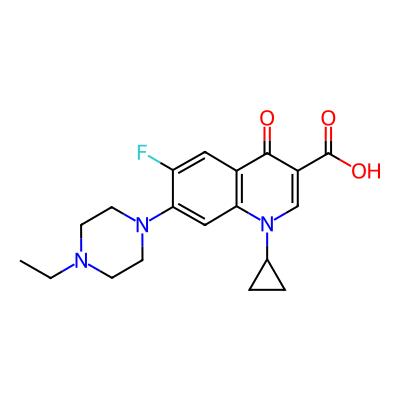
Enrofloxacin
| Chemical identification | |
|---|---|
| Unique Identifier | RID00301 |
| CAS identifier | 93106-60-6 |
| PubChem identifier | 71188 |
| DSSTox identifier | DTXSID1045619 |
| Molecular weight | 359.401 g/mol |
| SMILES | CCN1CCN(CC1)c1cc2c(cc1F)c(=O)c(cn2C1CC1)C(=O)O |
| InChI | InChI=1S/C19H22FN3O3/c1-2-21-5-7-22(8-6-21)17-10-16-13(9-15(17)20)18(24)14(19(25)26)11-23(16)12-3-4-12/h9-12H,2-8H2,1H3,(H,25,26) |
| InChIKey | InChIkey=SPFYMRJSYKOXGV-UHFFFAOYSA-N |
2D:2D MOL2D MOL22D SDF
3D:3D MOL3D MOL23D SDF3D PDB3D PDBQT
| Chemical classification | |
|---|---|
| Kingdom | Organic compounds |
| Superclass | Organoheterocyclic compounds |
| Class | Quinolines and derivatives |
| Regulatory Information |
|---|
| Regulation | Country | Status |
|---|---|---|
| ASEAN: Banned in Fish for Food Consumption | Singapore | Total banned |
| ASEAN: Antibiotics in Ornamental Fish | Thailand | Total banned |
| ASEAN: Antibiotics in Ornamental Fish | Viet Nam | Total banned |
| ASEAN: Antibiotics in Fish for Food Consumption | Brunei Darussalam | Total banned |
| ASEAN: Antibiotics in Fish for Food Consumption | Thailand | Total banned |
| ASEAN: Antibiotics in Fish for Food Consumption | Viet Nam | Total banned |
| Reference | Country of Study | Regulatory Status | Regulating Country | Usage Status |
|---|---|---|---|---|
| PMID: 35909695 | China | No known regulations | Tested | |
| PMID: 35335647 | China | No known regulations | Tested | |
| PMID: 30184134 | China | No known regulations | Tested | |
| PMID: 38659458 | China | No known regulations | Actively Used | |
| PMID: 33372840 | China | No known regulations | Tested | |
| PMID: 32349419 | China | No known regulations | Tested | |
| PMID: 17292447 | Spain | No known regulations | Actively Used | |
| PMID: 40076989 | China | No known regulations | Tested | |
| PMID: 37894188 | China | No known regulations | Tested | |
| PMID: 36790271 | Brazil | No known regulations | Tested | |
| PMID: 34650438 | China | No known regulations | Tested | |
| PMID: 35884183 | China | No known regulations | Tested |
DISCLAIMER
ReCAnt is a database of chemicals used in aquaculture and their ecotoxic effects, compiled from published literature. The authors are not liable for any inaccuracies or omissions of any chemicals in this resource. Importantly, our sole goal to build this resource on chemicals used in aquaculture is to enable future basic research on this topic, and it does not necessarily reflect the views or objectives of our employers or funders.