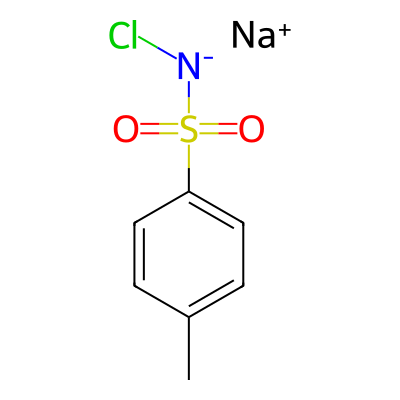
Chloramine-T
ECOTOX: Acute Toxicity
Download
| Latin Name | Species Group | Endpoint | PPM Equivalent | Trend | Effect | Measurement |
|---|---|---|---|---|---|---|
| Daphnia magna | Crustaceans | EC50 | 4.8 | Increasing | Intoxication | Immobile |
| Daphnia magna | Crustaceans | EC50 | 4.8 | Not reported | Behavior | Equilibrium |
| Ictalurus punctatus | Fish | LC50 | 11.217 | Not reported | Mortality | Mortality |
| Oncorhynchus mykiss | Fish | LC50 | 14.656 | Not reported | Mortality | Mortality |
| Pimephales promelas | Fish | LC50 | 16.055 | Not reported | Mortality | Mortality |
ECOTOX: Chronic Toxicity
Download
| Latin Name | Species Group | Endpoint | PPM Equivalent | Trend | Effect | Measurement |
|---|---|---|---|---|---|---|
| Daphnia magna | Crustaceans | NOEC | 1.3 | Change | Reproduction | Progeny counts/numbers |
| Daphnia magna | Crustaceans | NOEC | 1.3 | Change | Reproduction | Time to first progeny |
| Daphnia magna | Crustaceans | NOEC | 1.3 | Not reported | Behavior | Equilibrium |
| Oncorhynchus mykiss | Fish | NOEC | 10 | Decreasing | Biochemistry | Antioxidant activity |
| Oncorhynchus mykiss | Fish | NOEC | 10 | Decreasing | Biochemistry | Ketone |
| Oncorhynchus mykiss | Fish | NOEC | 10 | Decreasing | Biochemistry | Oxidative Status Index |
| Oncorhynchus mykiss | Fish | NOEC | 10 | Decreasing | Biochemistry | Thiobarbituric acid reactive substances |
| Oncorhynchus mykiss | Fish | NOEC | 10 | Decreasing | Cell(s) | Number of cells |
| Oncorhynchus mykiss | Fish | NOEC | 10 | Decreasing | Cell(s) | Volume |
| Oncorhynchus mykiss | Fish | NOEC | 10 | Decreasing | Cell(s) | Width |
| Oncorhynchus mykiss | Fish | NOEC | 10 | Decreasing | Enzyme(s) | Catalase |
| Oncorhynchus mykiss | Fish | NOEC | 10 | Decreasing | Enzyme(s) | Glutathione peroxidase |
| Oncorhynchus mykiss | Fish | NOEC | 10 | Decreasing | Enzyme(s) | Glutathione reductase |
| Oncorhynchus mykiss | Fish | NOEC | 10 | Decreasing | Morphology | Thickness |
| Oncorhynchus mykiss | Fish | NOEC | 10 | Increasing | Morphology | Thickness |
ECOTOX: Bioconcentration (BCF)
Download
No ECOTOX bioconcentration data available.
DISCLAIMER
ReCAnt is a database of chemicals used in aquaculture and their ecotoxic effects, compiled from published literature. The authors are not liable for any inaccuracies or omissions of any chemicals in this resource. Importantly, our sole goal to build this resource on chemicals used in aquaculture is to enable future basic research on this topic, and it does not necessarily reflect the views or objectives of our employers or funders.