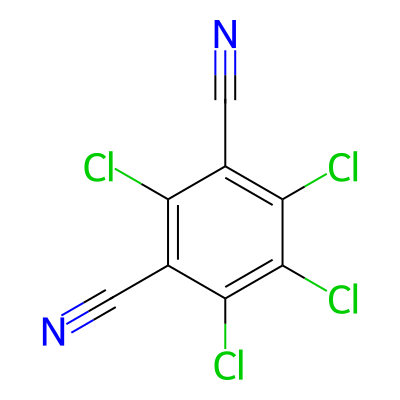
Chlorothalonil
Effects reported:
Enzyme(s)
Biochemistry
Cell(s)
Genetics
Injury
← Scroll →
ⓘ Table glossary
Table glossary
ReferencePubMed ID of research paper
Experimental TypeIn vivo or in vitro
Cell / TissueIf in vitro, cells derived from aquaculture-relevant species
Cell / TissueIf in vitro, tissues obtained from aquaculture-relevant species
Cell / TissueIf in vivo, left blank
Test OrganismAquaculture-relevant species tested for toxic effect
LifestageLifestage of the test organism if mentioned in the reference
AdministrationRoute by which the chemical enters the test organism or treatment method
Administered dose rangeDifferent doses of chemicals tested in this study
Significant dose rangeSignificant result(s) at specific doses
Trend
Direction of effect over time
Measurement
Parameter used to quantify the effect
Effect
Overall observed biological outcome or toxicological effect
| Reference | Experiment type | Cell / tissue | Test organism | Lifestage | Administration | Administered dose | Significant dose | Trend | Measurement | Effect |
|---|---|---|---|---|---|---|---|---|---|---|
| PMID:33774206 | In vivo | - | Oreochromis niloticus | - | Water treatment | 20.0-140.0 µg/L |
20.0-140.0 µg/L |
Decreased | Glutathione peroxidase | Enzyme(s) |
| In vivo | - | Oreochromis niloticus | - | Water treatment | 20.0-140.0 µg/L |
20.0-140.0 µg/L |
Decreased | Hydrogen peroxide | Biochemistry | |
| In vivo | - | Oreochromis niloticus | - | Water treatment | 20.0-140.0 µg/L |
20.0-140.0 µg/L |
Decreased | Reactive oxygen species scavenging capacity | Cell(s) | |
| In vivo | - | Oreochromis niloticus | - | Water treatment | 20.0-140.0 µg/L |
20.0-140.0 µg/L |
Decreased | Superoxide | Biochemistry | |
| In vivo | - | Oreochromis niloticus | - | Water treatment | 20.0-140.0 µg/L |
20.0-140.0 µg/L |
Decreased | Total antioxidant capacity | Biochemistry | |
| In vivo | - | Oreochromis niloticus | - | Water treatment | 40 µg/L |
40 µg/L |
Increased | Caspase 3 mRNA | Genetics | |
| In vivo | - | Oreochromis niloticus | - | Water treatment | 40 µg/L |
40 µg/L |
Increased | MCM3 mRNA | Genetics | |
| In vivo | - | Oreochromis niloticus | - | Water treatment | 20.0-140.0 µg/L |
20.0-140.0 µg/L |
Increased | Malondialdehyde | Biochemistry | |
| In vivo | - | Oreochromis niloticus | - | Water treatment | 40.0-140.0 µg/L |
40.0-140.0 µg/L |
Increased | Nitric Oxide concentration | Biochemistry | |
| In vivo | - | Oreochromis niloticus | - | Water treatment | 20.0-140.0 µg/L |
20.0-140.0 µg/L |
Increased | Tissue damage in the brain | Injury | |
| In vivo | - | Oreochromis niloticus | - | Water treatment | 20.0-140.0 µg/L |
20.0-140.0 µg/L |
Increased | Tissue damage in the gills | Injury | |
| In vivo | - | Oreochromis niloticus | - | Water treatment | 20.0-140.0 µg/L |
20.0-140.0 µg/L |
Increased | Tissue damage in the heart | Injury | |
| In vivo | - | Oreochromis niloticus | - | Water treatment | 20.0-140.0 µg/L |
20.0-140.0 µg/L |
Increased | Tissue damage in the intestine | Injury | |
| In vivo | - | Oreochromis niloticus | - | Water treatment | 20.0-140.0 µg/L |
20.0-140.0 µg/L |
Increased | Tissue damage in the liver | Injury | |
| In vivo | - | Oreochromis niloticus | - | Water treatment | 20.0-140.0 µg/L |
20.0-140.0 µg/L |
Increased | Tissue damage in the muscle | Injury | |
| In vivo | - | Oreochromis niloticus | - | Water treatment | 20.0-140.0 µg/L |
20.0-140.0 µg/L |
Increased | Tissue damage in the spleen | Injury | |
| In vivo | - | Oreochromis niloticus | - | Water treatment | 40 µg/L |
40 µg/L |
Increased | p53 mRNA | Genetics |
Glossary
×
ReferencePubMed ID of research paper
Experimental TypeIn vivo or in vitro
Cell / TissueIf in vitro, cells derived from aquaculture-relevant species
Cell / TissueIf in vitro, tissues obtained from aquaculture-relevant species
Cell / TissueIf in vivo, left blank
Test OrganismAquaculture-relevant species tested for toxic effect
LifestageLifestage of the test organism if mentioned in the reference
AdministrationRoute by which the chemical enters the test organism or treatment method
Administered dose rangeDifferent doses of chemicals tested in this study
Significant dose rangeSignificant result(s) at specific doses
Trend
Direction of effect over time
Measurement
Parameter used to quantify the effect
Effect
Overall observed biological outcome or toxicological effect
DISCLAIMER
ReCAnt is a database of chemicals used in aquaculture and their ecotoxic effects, compiled from published literature. The authors are not liable for any inaccuracies or omissions of any chemicals in this resource. Importantly, our sole goal to build this resource on chemicals used in aquaculture is to enable future basic research on this topic, and it does not necessarily reflect the views or objectives of our employers or funders.