Tattoos and permanent makeup (PMU), which involve the intradermal injection of chemical pigments, have witnessed a substantial rise in popularity across the globe. Recent surveys indicate that nearly 40% of young adults in Europe and North America now have at least one tattoo [Luamann and Derrick, 2006, Kluger et al., 2019]. Despite their widespread use, modern tattoo inks contain a complex mixture of chemicals, many of which fall outside the scope of cosmetic-relevant regulations. Recent reports on adverse effects, such as skin cancers and lymphomas, linked to tattoo inks have raised significant public health concerns [Nielsen et al., 2024, Clemmensen et al., 2025].
One of the major challenges in ensuring the safety of tattoo inks is the lack of systematic information on their chemical composition and associated toxicological information. To address this gap, we present Tattoo Ink Chemicals and associated Toxicities Knowledgebase (TICToK) that compiles and curates 364 unique tattoo ink chemicals from various regulatory and scientific resources. The first version of TICToK was released on 1 August 2025.
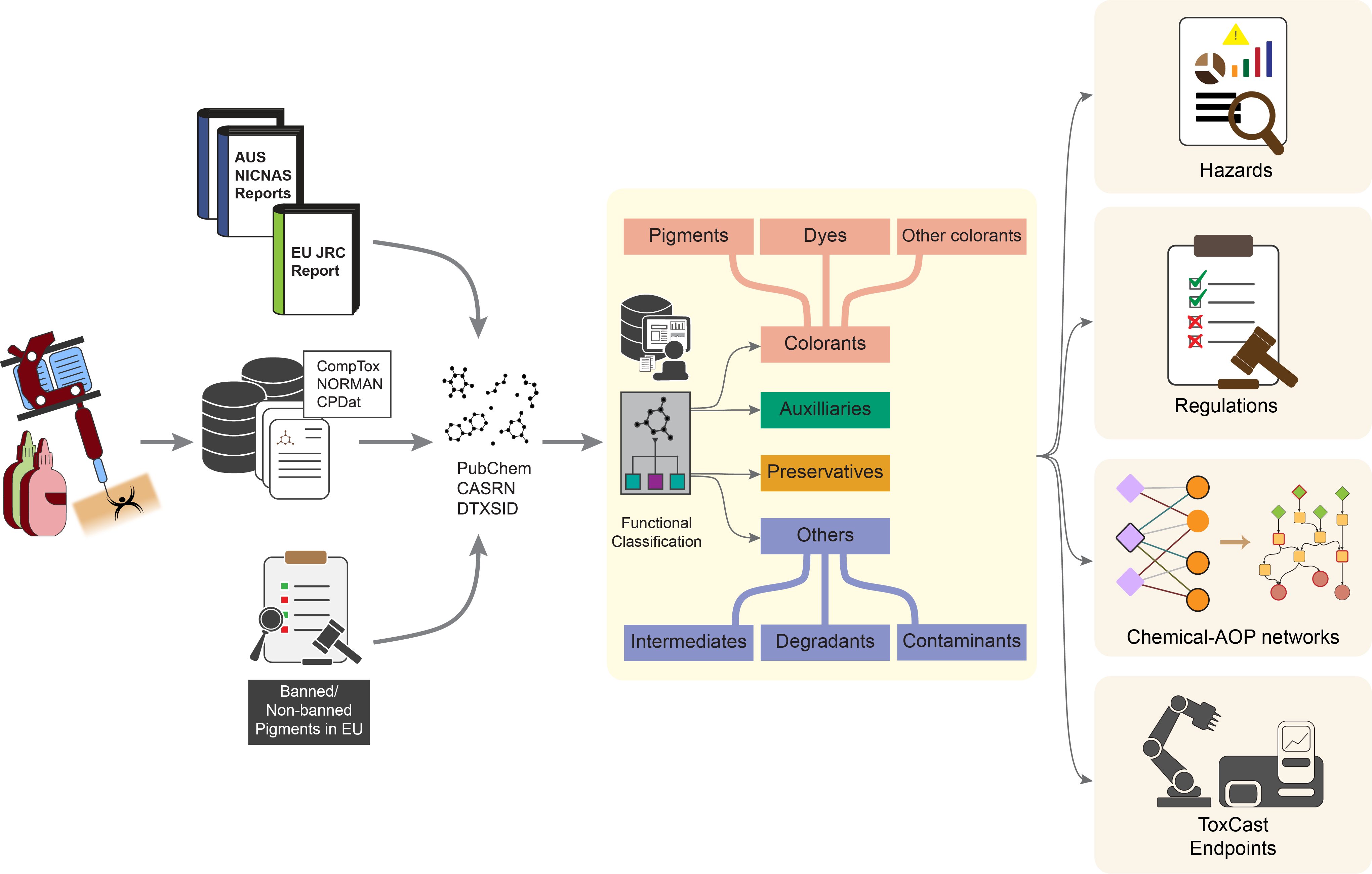
In TICToK, chemicals are categorized based on their functions in tattoo inks, such as:
- Pigments: color imparting chemicals that are insoluble in the solvent they are incorporated in
- Dyes: color imparting chemicals that are soluble in the solvent they are incorporated in
- Auxiliaries: chemicals added to improve performance, stability or usability of tattoo inks (e.g., solvents, binders, stabilizers, etc.)
- Preservatives: chemicals protecting against bacterial contamination
- Degradants: chemicals that are released upon breakdown of colorants
- Intermediates: chemicals that are used in the production of colorants
- Contaminants: unintended or unwanted chemicals present in tattoo inks
In TICToK, each chemical has been mapped to their standard identifiers such as Chemical Abstracts Service Registry Number (CASRN), PubChem identifier, DSSTox identifier, canonical SMILES, InChI and InChIKey. Furthermore, TICToK provides users with chemical information such as 2D and 3D structures, chemical characterization (Classyfire), physicochemical properties, molecular descriptors, predicted ADMET properties, associated hazards, associated regulatory coverage, associated adverse outcome pathways within AOP-Wiki, and associated toxicological endpoints compiled from ToxCast.
CITATION
If you use our resource, please cite the following research article:N. Chivukula et al., TICToK: A comprehensive knowledgebase of tattoo ink chemicals and investigation of their associated toxicities and regulations, bioRxiv, 10.1101/2025.08.02.668261 (2025).
DISCLAIMER
TICToK is a knowledgebase of chemicals found in tattoo inks, compiled from publicly available regulatory and scientific resources. The chemical classifications presented in this knowledgebase are derived from multiple publicly available resources and are provided solely for informational purposes, and they are neither authoritative nor binding. The chemical-AOP mappings compiled in this knowledgebase serve as plausible hypotheses for research, and further experimental validation is required to definitively establish these potential toxicity mechanisms. The authors bear no responsibility for any errors, omissions, or inconsistencies originating from these external sources. Users are advised to exercise independent judgment when interpreting chemical classifications and any other data provided in this resource. Importantly, our sole goal to build this resource on tattoo ink chemicals is to enable future basic research on this topic, and it does not necessarily reflect the views or objectives of our employers or funders.