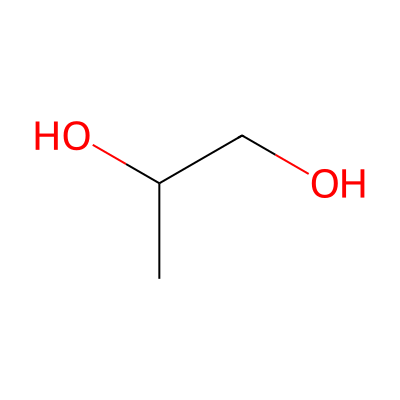
1,2-Propylene glycol
| Associated curated AOPs from AOP-Wiki |
|---|
Associated AOPs with Level of Relevance 1
AOPs with at least 1 KE associated with chemical, where the KE(s) are neither MIE nor AO
| AOP Identifier | AOP Title | AO Classification | OECD Status | Coverage Score | KE Identifier | KE Name |
|---|---|---|---|---|---|---|
| AOP:41 | Sustained AhR Activation leading to Rodent Liver Tumours | Cancer; Gastrointestinal System Disease | Under Review | 0.4 | KE:853 | Changes/Inhibition, Cellular Homeostasis and Apoptosis |
| KE:139 | N/A, Hepatotoxicity, Hepatopathy, including a constellation of observable effects | |||||
| AOP:64 | Glucocorticoid Receptor (GR) Mediated Adult Leydig Cell Dysfunction Leading to Decreased Male Fertility | Reproductive System Disease | - | 0.14 | KE:496 | Increased apoptosis, decreased fetal/adult Leydig Cells |
| AOP:108 | Inhibition of pyruvate dehydrogenase kinase leading to hepatocellular adenomas and carcinomas (in mouse and rat) | Cancer; Gastrointestinal System Disease | - | 0.17 | KE:768 | Increase, Cytotoxicity |
| AOP:136 | Intracellular Acidification Induced Olfactory Epithelial Injury Leading to Site of Contact Nasal Tumors | Benign Neoplasm; Respiratory System Disease | Under Review | 0.14 | KE:768 | Increase, Cytotoxicity |
| AOP:207 | NADPH oxidase and P38 MAPK activation leading to reproductive failure in Caenorhabditis elegans | Reproductive System Disease | - | 0.12 | KE:1262 | Apoptosis |
| AOP:212 | Histone deacetylase inhibition leading to testicular atrophy | Reproductive System Disease | WPHA/WNT Endorsed | 0.17 | KE:1262 | Apoptosis |
| AOP:220 | Cyp2E1 Activation Leading to Liver Cancer | Cancer; Gastrointestinal System Disease | WPHA/WNT Endorsed | 0.2 | KE:1393 | Hepatocytotoxicity |
| AOP:419 | Aryl hydrocarbon receptor activation leading to impaired lung function through P53 toxicity pathway | Respiratory System Disease | - | 0.25 | KE:1262 | Apoptosis |
| AOP:439 | Activation of the AhR leading to metastatic breast cancer | Thoracic Disease; Cancer | Under Development | 0.11 | KE:1262 | Apoptosis |
| AOP:441 | Ionizing radiation-induced DNA damage leads to microcephaly via apoptosis and premature cell differentiation | Congenital Nervous System Abnormality; Nervous System Disease | - | 0.14 | KE:1262 | Apoptosis |
| AOP:446 | PM-related Adverse outcome pathway frameworks on various systems | Respiratory System Disease | - | 0.05 | KE:1262 | Apoptosis |
| AOP:447 | Kidney failure induced by inhibition of mitochondrial electron transfer chain through apoptosis, inflammation and oxidative stress pathways | Urinary System Disease | - | 0.08 | KE:1097 | Occurrence, renal proximal tubular necrosis |
| AOP:452 | Adverse outcome pathway of PM-induced respiratory toxicity | Respiratory System Disease | - | 0.09 | KE:1262 | Apoptosis |
| AOP:460 | Antagonism of Smoothened receptor leading to orofacial clefting | Unclassified | Under Development | 0.11 | KE:1262 | Apoptosis |
| AOP:463 | The AOP framwork on silica nanopariticles induced hepatoxicity | Gastrointestinal System Disease | - | 0.09 | KE:1262 | Apoptosis |
| AOP:465 | Alcohol dehydrogenase leading to reproductive dysfunction | Unclassified | - | 0.12 | KE:748 | Increased, Estrogen receptor (ER) activity |
| AOP:472 | DNA adduct formation leading to kidney failure | Urinary System Disease | - | 0.11 | KE:1097 | Occurrence, renal proximal tubular necrosis |
| AOP:491 | Decrease, GLI1/2 target gene expression leads to orofacial clefting | Unclassified | Under Development | 0.17 | KE:1262 | Apoptosis |
| AOP:495 | Androgen receptor activation leading to prostate cancer | Reproductive System Disease; Cancer | - | 0.11 | KE:1183 | Decreased, Apoptosis (Epithelial Cells) |
| AOP:500 | Activation of MEK-ERK1/2 leads to deficits in learning and cognition via ROS and apoptosis | Developmental Disorder Of Mental Health | - | 0.14 | KE:1262 | Apoptosis |
| AOP:535 | Binding and activation of GPER leading to learning and memory impairments | Developmental Disorder Of Mental Health | - | 0.11 | KE:1262 | Apoptosis |
| AOP:540 | Oxidative Stress in the Fish Ovary Leads to Reproductive Impairment via Reduced Vitellogenin Production | Unclassified | - | 0.11 | KE:1262 | Apoptosis |
| AOP:563 | Aryl hydrocarbon Receptor (AHR) activation causes Premature Ovarian Insufficiency via Bax mediated apoptosis | Reproductive System Disease; Endocrine System Disease | - | 0.17 | KE:1262 | Apoptosis |
Associated AOPs with Level of Relevance 2
AOPs with at least 1 AO associated with chemical, and no associated MIE
| AOP Identifier | AOP Title | AO Classification | OECD Status | Coverage Score | KE Identifier | KE Name |
|---|---|---|---|---|---|---|
| AOP:6 | Antagonist binding to PPARα leading to body-weight loss | Symptom | WPHA/WNT Endorsed | 0.12 | KE:864 | Decreased, Body Weight |
| AOP:205 | AOP from chemical insult to cell death | Unclassified | - | 0.17 | KE:1262 | Apoptosis |
| AOP:278 | IKK complex inhibition leading to liver injury | Unclassified | - | 0.12 | KE:1549 | Liver Injury |
| AOP:379 | Binding to ACE2 leading to thrombosis and disseminated intravascular coagulation | Cardiovascular System Disease | Under Development | 0.14 | KE:1846 | Thrombosis and Disseminated Intravascular Coagulation |
| AOP:384 | Hyperactivation of ACE/Ang-II/AT1R axis leading to chronic kidney disease | Urinary System Disease | - | 0.17 | KE:1603 | Chronic kidney disease |
| AOP:504 | SULT1E1 inhibition leading to uterine adenocarcinoma via increased estrogen availability at target organ level | Unclassified | - | 0.33 | KE:1065 | Activation, estrogen receptor alpha |
| AOP:561 | Aromatase induction leading to estrogen receptor alpha activation via increased estradiol | Unclassified | - | 0.2 | KE:1065 | Activation, estrogen receptor alpha |
Associated AOPs with Level of Relevance 3
AOPs with at least 1 MIE associated with chemical, and no associated AO
| AOP Identifier | AOP Title | AO Classification | OECD Status | Coverage Score | KE Identifier | KE Name |
|---|---|---|---|---|---|---|
| AOP:118 | Chronic cytotoxicity leading to hepatocellular adenomas and carcinomas (in mouse and rat) | Cancer; Gastrointestinal System Disease | - | 0.25 | KE:786 | Increase, Cytotoxicity (hepatocytes) |
| AOP:167 | Early-life estrogen receptor activity leading to endometrial carcinoma in the mouse. | Reproductive System Disease; Cancer | - | 0.29 | KE:1064 | prepubertal increase, Estrogen receptor (ER) activity |
| KE:1065 | Activation, estrogen receptor alpha | |||||
| AOP:209 | Perturbation of cholesterol and glutathione homeostasis leading to hepatotoxicity: Integrated multi-OMICS approach for building AOP | Gastrointestinal System Disease | - | 0.12 | KE:1286 | Down Regulation, GSS and GSTs gene |
| AOP:314 | Binding to estrogen receptor (ER)-α in immune cells leading to exacerbation of systemic lupus erythematosus (SLE) | Immune System Disease; Musculoskeletal System Disease | Under Development | 0.2 | KE:1710 | Binding to estrogen receptor (ER)-α in immune cells |
| AOP:445 | Estrogen Receptor Alpha Agonism leads to Impaired Reproduction | Reproductive System Disease | - | 0.12 | KE:1065 | Activation, estrogen receptor alpha |
| AOP:503 | Activation of uterine estrogen receptor-alfa leading to endometrial adenocarcinoma, via epigenetic modulation | Reproductive System Disease; Cancer | Under Review | 0.17 | KE:1065 | Activation, estrogen receptor alpha |
DISCLAIMER
TICToK is a knowledgebase of chemicals found in tattoo inks, compiled from publicly available regulatory and scientific resources. The chemical classifications presented in this knowledgebase are derived from multiple publicly available resources and are provided solely for informational purposes, and they are neither authoritative nor binding. The chemical-AOP mappings compiled in this knowledgebase serve as plausible hypotheses for research, and further experimental validation is required to definitively establish these potential toxicity mechanisms. The authors bear no responsibility for any errors, omissions, or inconsistencies originating from these external sources. Users are advised to exercise independent judgment when interpreting chemical classifications and any other data provided in this resource. Importantly, our sole goal to build this resource on tattoo ink chemicals is to enable future basic research on this topic, and it does not necessarily reflect the views or objectives of our employers or funders.