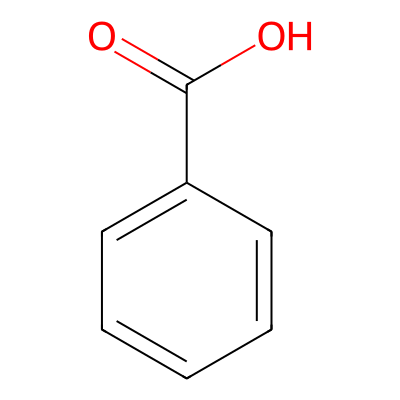
Benzoic acid
| Associated curated AOPs from AOP-Wiki |
|---|
Associated AOPs with Level of Relevance 1
AOPs with at least 1 KE associated with chemical, where the KE(s) are neither MIE nor AO
| AOP Identifier | AOP Title | AO Classification | OECD Status | Coverage Score | KE Identifier | KE Name |
|---|---|---|---|---|---|---|
| AOP:96 | Axonal sodium channel modulation leading to acute mortality | Unclassified | - | 0.17 | KE:602 | Increased, Ataxia, paralysis, or hyperactivity |
| AOP:112 | Increased dopaminergic activity leading to endometrial adenocarcinomas (in Wistar rat) | Reproductive System Disease; Cancer | - | 0.17 | KE:111 | Agonism, Estrogen receptor |
| AOP:113 | Glutamate-gated chloride channel activation leading to acute mortality | Unclassified | - | 0.17 | KE:764 | N/A, Ataxia, paralysis, or hyperactivity |
| AOP:465 | Alcohol dehydrogenase leading to reproductive dysfunction | Unclassified | - | 0.12 | KE:748 | Increased, Estrogen receptor (ER) activity |
Associated AOPs with Level of Relevance 2
AOPs with at least 1 AO associated with chemical, and no associated MIE
| AOP Identifier | AOP Title | AO Classification | OECD Status | Coverage Score | KE Identifier | KE Name |
|---|---|---|---|---|---|---|
| AOP:270 | Elevated ATP demand for detoxification and repair mechanisms leading to impaired locomotor activity | Unclassified | - | 0.12 | KE:10016 | Impaired locomotor activity |
| AOP:504 | SULT1E1 inhibition leading to uterine adenocarcinoma via increased estrogen availability at target organ level | Unclassified | - | 0.33 | KE:1065 | Activation, estrogen receptor alpha |
| AOP:561 | Aromatase induction leading to estrogen receptor alpha activation via increased estradiol | Unclassified | - | 0.2 | KE:1065 | Activation, estrogen receptor alpha |
Associated AOPs with Level of Relevance 3
AOPs with at least 1 MIE associated with chemical, and no associated AO
| AOP Identifier | AOP Title | AO Classification | OECD Status | Coverage Score | KE Identifier | KE Name |
|---|---|---|---|---|---|---|
| AOP:16 | Acetylcholinesterase inhibition leading to acute mortality | Unclassified | Under Development | 0.14 | KE:12 | Acetylcholinesterase (AchE) Inhibition |
| AOP:167 | Early-life estrogen receptor activity leading to endometrial carcinoma in the mouse. | Reproductive System Disease; Cancer | - | 0.29 | KE:1064 | prepubertal increase, Estrogen receptor (ER) activity |
| KE:1065 | Activation, estrogen receptor alpha | |||||
| AOP:281 | Acetylcholinesterase Inhibition Leading to Neurodegeneration | Nervous System Disease | - | 0.1 | KE:12 | Acetylcholinesterase (AchE) Inhibition |
| AOP:312 | Acetylcholinesterase Inhibition leading to Acute Mortality via Impaired Coordination & Movement | Unclassified | - | 0.17 | KE:12 | Acetylcholinesterase (AchE) Inhibition |
| AOP:314 | Binding to estrogen receptor (ER)-α in immune cells leading to exacerbation of systemic lupus erythematosus (SLE) | Immune System Disease; Musculoskeletal System Disease | Under Development | 0.2 | KE:1710 | Binding to estrogen receptor (ER)-α in immune cells |
| AOP:405 | Organo-Phosphate Chemicals induced inhibition of AChE leading to impaired cognitive function | Cognitive Disorder | - | 0.2 | KE:12 | Acetylcholinesterase (AchE) Inhibition |
| AOP:445 | Estrogen Receptor Alpha Agonism leads to Impaired Reproduction | Reproductive System Disease | - | 0.12 | KE:1065 | Activation, estrogen receptor alpha |
| AOP:450 | Inhibition of AChE and activation of CYP2E1 leading to sensory axonal peripheral neuropathy and mortality | Nervous System Disease | - | 0.14 | KE:12 | Acetylcholinesterase (AchE) Inhibition |
| AOP:503 | Activation of uterine estrogen receptor-alfa leading to endometrial adenocarcinoma, via epigenetic modulation | Reproductive System Disease; Cancer | Under Review | 0.17 | KE:1065 | Activation, estrogen receptor alpha |
| AOP:536 | Estrogen receptor agonism leading to reduced survival and population growth due to renal failure | Unclassified | - | 0.17 | KE:111 | Agonism, Estrogen receptor |
| AOP:537 | Estrogen receptor agonism leads to reduced fecundity via increased vitellogenin in the liver | Unclassified | - | 0.2 | KE:111 | Agonism, Estrogen receptor |
| AOP:559 | Inhibition of acetylcholinesterase (AChE) leading to arrhythmias | Symptom | - | 0.2 | KE:12 | Acetylcholinesterase (AchE) Inhibition |
DISCLAIMER
TICToK is a knowledgebase of chemicals found in tattoo inks, compiled from publicly available regulatory and scientific resources. The chemical classifications presented in this knowledgebase are derived from multiple publicly available resources and are provided solely for informational purposes, and they are neither authoritative nor binding. The chemical-AOP mappings compiled in this knowledgebase serve as plausible hypotheses for research, and further experimental validation is required to definitively establish these potential toxicity mechanisms. The authors bear no responsibility for any errors, omissions, or inconsistencies originating from these external sources. Users are advised to exercise independent judgment when interpreting chemical classifications and any other data provided in this resource. Importantly, our sole goal to build this resource on tattoo ink chemicals is to enable future basic research on this topic, and it does not necessarily reflect the views or objectives of our employers or funders.