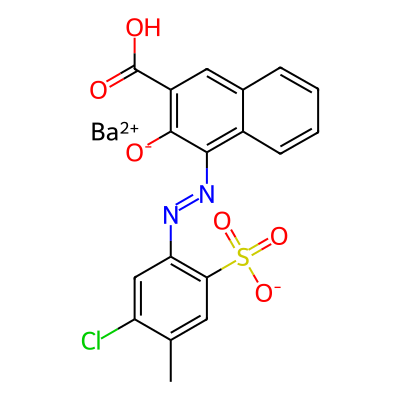
Barium 4-((5-chloro-4-methyl-2-sulphonatophenyl)azo)-3-hydroxy-2-naphthoate
| Associated curated AOPs from AOP-Wiki |
|---|
Associated AOPs with Level of Relevance 1
AOPs with at least 1 KE associated with chemical, where the KE(s) are neither MIE nor AO
| AOP Identifier | AOP Title | AO Classification | OECD Status | Coverage Score | KE Identifier | KE Name |
|---|---|---|---|---|---|---|
| AOP:64 | Glucocorticoid Receptor (GR) Mediated Adult Leydig Cell Dysfunction Leading to Decreased Male Fertility | Reproductive System Disease | - | 0.14 | KE:520 | Decreased sperm quantity or quality in the adult, Decreased fertility |
| AOP:136 | Intracellular Acidification Induced Olfactory Epithelial Injury Leading to Site of Contact Nasal Tumors | Benign Neoplasm; Respiratory System Disease | Under Review | 0.14 | KE:868 | Increase, Tissue Degeneration, Necrosis & Atrophy |
Associated AOPs with Level of Relevance 2
AOPs with at least 1 AO associated with chemical, and no associated MIE
| AOP Identifier | AOP Title | AO Classification | OECD Status | Coverage Score | KE Identifier | KE Name |
|---|---|---|---|---|---|---|
| AOP:212 | Histone deacetylase inhibition leading to testicular atrophy | Reproductive System Disease | WPHA/WNT Endorsed | 0.17 | KE:1506 | Testicular atrophy |
| AOP:322 | Alkylation of DNA leading to reduced sperm count | Reproductive System Disease | - | 0.2 | KE:1757 | Reduce, Sperm count |
DISCLAIMER
TICToK is a knowledgebase of chemicals found in tattoo inks, compiled from publicly available regulatory and scientific resources. The chemical classifications presented in this knowledgebase are derived from multiple publicly available resources and are provided solely for informational purposes, and they are neither authoritative nor binding. The chemical-AOP mappings compiled in this knowledgebase serve as plausible hypotheses for research, and further experimental validation is required to definitively establish these potential toxicity mechanisms. The authors bear no responsibility for any errors, omissions, or inconsistencies originating from these external sources. Users are advised to exercise independent judgment when interpreting chemical classifications and any other data provided in this resource. Importantly, our sole goal to build this resource on tattoo ink chemicals is to enable future basic research on this topic, and it does not necessarily reflect the views or objectives of our employers or funders.