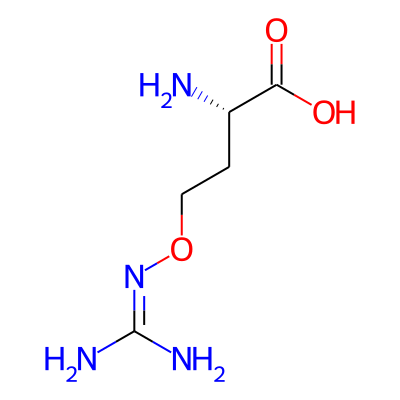
| Property name | Tool | Property value |
|---|---|---|
| Molecular weight (g/mol) | RDKit | 176.18 |
| Log P | RDKit | -2.01 |
| Topological polar surface area (Å2) | RDKit | 136.95 |
| Number of hydrogen bond acceptors | RDKit | 4 |
| Number of hydrogen bond donors | RDKit | 4 |
| Number of carbon atoms | RDKit | 5 |
| Number of heavy atoms | RDKit | 12 |
| Number of heteroatoms | RDKit | 7 |
| Number of nitrogen atoms | RDKit | 4 |
| Number of sulfur atoms | RDKit | 0 |
| Number of chiral carbon atoms | RDKit | 1 |
| Stereochemical complexity | RDKit | 0.2 |
| Number of sp hybridized carbon atoms | RDKit | 0 |
| Number of sp2 hybridized carbon atoms | RDKit | 2 |
| Number of sp3 hybridized carbon atoms | RDKit | 3 |
| Shape complexity | RDKit | 0.6 |
| Number of rotatable bonds | RDKit | 5 |
| Number of aliphatic carbocycles | RDKit | 0 |
| Number of aliphatic heterocycles | RDKit | 0 |
| Number of aliphatic rings | RDKit | 0 |
| Number of aromatic carbocycles | RDKit | 0 |
| Number of aromatic heterocycles | RDKit | 0 |
| Number of aromatic rings | RDKit | 0 |
| Total number of rings | RDKit | 0 |
| Number of saturated carbocycles | RDKit | 0 |
| Number of saturated heterocycles | RDKit | 0 |
| Number of saturated rings | RDKit | 0 |
| Number of Smallest Set of Smallest Rings (SSSR) | RDKit | 0 |
| Property name | Tool | Property value |
|---|---|---|
| Number of Lipinski’s rule of 5 violations | RDKit | 0 |
| Lipinski’s rule of 5 | RDKit | Passed |
| Number of Ghose rule violations | RDKit | 1 |
| Ghose rule | RDKit | Failed |
| Veber rule | RDKit | Good |
| Egan rule | RDKit | Bad |
| GSK 4/400 rule | RDKit | Good |
| Pfizer 3/75 rule | RDKit | Good |
| Weighted quantitative estimate of drug-likeness (QEDw) score | RDKit | 0.17 |
| Property name | Tool | Property value |
|---|---|---|
| Bioavailability score | SwissADME | 0.55 |
| Solubility class [ESOL] | SwissADME | Highly soluble |
| Solubility class [Silicos-IT] | SwissADME | Soluble |
| Blood Brain Barrier permeation | SwissADME | No |
| Gastrointestinal absorption | SwissADME | Low |
| Log Kp (Skin permeation, cm/s) | SwissADME | -10.77 |
| Number of PAINS structural alerts | SwissADME | 0 |
| Number of Brenk structural alerts | SwissADME | 3 |
| CYP1A2 inhibitor | SwissADME | No |
| CYP2C19 inhibitor | SwissADME | No |
| CYP2C9 inhibitor | SwissADME | No |
| CYP2D6 inhibitor | SwissADME | No |
| CYP3A4 inhibitor | SwissADME | No |
| P-glycoprotein substrate | SwissADME | No |
| Protein identifier | HGNC symbol | Combined score from STITCH database |
|---|---|---|
| ENSP00000357066 | ARG1 | 911 |
| ENSP00000370109 | PSIP1 | 800 |
| ENSP00000436786 | KMT2A | 800 |
| ENSP00000387230 | UPP2 | 800 |
| ENSP00000307188 | ASL | 909 |
| ENSP00000327251 | NOS2 | 844 |
| ENSP00000231572 | RARS | 814 |
| ENSP00000337459 | NOS1 | 839 |
| ENSP00000306328 | SLC25A33 | 800 |
| ENSP00000297494 | NOS3 | 966 |
