IMPPAT Phytochemical information: 
Chrysophanol-9-anthrone

Chrysophanol-9-anthrone
Summary

SMILES: Cc1cc2Cc3cccc(c3C(=O)c2c(c1)O)O
InChI: InChI=1S/C15H12O3/c1-8-5-10-7-9-3-2-4-11(16)13(9)15(18)14(10)12(17)6-8/h2-6,16-17H,7H2,1H3
InChIKey: ZZBWSNKBZKPGAK-UHFFFAOYSA-N
DeepSMILES: CcccCcccccc6C=O)c%10cc%14)O)))))O
Scaffold Graph/Node/Bond level: O=C1c2ccccc2Cc2ccccc21
Scaffold Graph/Node level: OC1C2CCCCC2CC2CCCCC21
Scaffold Graph level: CC1C2CCCCC2CC2CCCCC21
Functional groups: cO; cC(=O)c
Chemical classification
ClassyFire Kingdom: Organic compounds
ClassyFire Superclass: Benzenoids
ClassyFire Class: Anthracenes
NP Classifier Biosynthetic pathway: Polyketides
NP Classifier Superclass: Polycyclic aromatic polyketides
NP Classifier Class: Anthraquinones and anthrones
Synonymous chemical names:
chrysophanol anthrone, chrysarobin, chrysophanic-acid-9-anthrone, chrysophanol-anthrone, chrysothrone, chrysophanic acid-9-anthrone, chrysophanic acid 9-anthrone, 1,8-dihydroxy-3-methyl-9-anthrone
External chemical identifiers:
CID:CID_68111; ChEMBL:CHEMBL122196; ChEBI:CHEBI:3686; ZINC:ZINC000002040462; FDASRS:6307EF51M1; SureChEMBL:SCHEMBL1003557
Chemical structure download
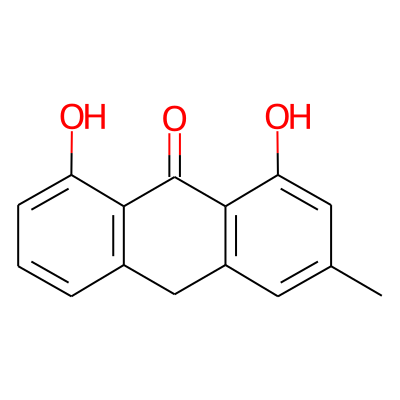

Chrysophanol-9-anthrone
Physicochemical properties
Property name Tool Property value
Molecular weight (g/mol) RDKit 240.26
Log P RDKit 2.54
Topological polar surface area (Å2) RDKit 57.53
Number of hydrogen bond acceptors RDKit 3
Number of hydrogen bond donors RDKit 2
Number of carbon atoms RDKit 15
Number of heavy atoms RDKit 18
Number of heteroatoms RDKit 3
Number of nitrogen atoms RDKit 0
Number of sulfur atoms RDKit 0
Number of chiral carbon atoms RDKit 0
Stereochemical complexity RDKit 0
Number of sp hybridized carbon atoms RDKit 0
Number of sp2 hybridized carbon atoms RDKit 13
Number of sp3 hybridized carbon atoms RDKit 2
Shape complexity RDKit 0.13
Number of rotatable bonds RDKit 0
Number of aliphatic carbocycles RDKit 1
Number of aliphatic heterocycles RDKit 0
Number of aliphatic rings RDKit 1
Number of aromatic carbocycles RDKit 2
Number of aromatic heterocycles RDKit 0
Number of aromatic rings RDKit 2
Total number of rings RDKit 3
Number of saturated carbocycles RDKit 0
Number of saturated heterocycles RDKit 0
Number of saturated rings RDKit 0
Number of Smallest Set of Smallest Rings (SSSR) RDKit 3


Chrysophanol-9-anthrone
Drug-likeness properties
Property nameToolProperty value
Number of Lipinski’s rule of 5 violations RDKit 0
Lipinski’s rule of 5 filter RDKit Passed
Number of Ghose filter violations RDKit 0
Ghose filter RDKit Passed
Veber filter RDKit Good
Pfizer 3/75 filter RDKit Bad
GSK 4/400 filter RDKit Good
Weighted quantitative estimate of drug-likeness (QEDw) score RDKit 0.634517


Chrysophanol-9-anthrone
ADME properties
Property nameToolProperty value
Bioavailability score SwissADME 0.55
Solubility class [ESOL] SwissADME Moderately soluble
Solubility class [Silicos-IT] SwissADME Moderately soluble
Blood Brain Barrier permeation SwissADME Yes
Gastrointestinal absorption SwissADME High
Log Kp (Skin permeation, cm/s) SwissADME -5.24
Number of PAINS structural alerts SwissADME 0
Number of Brenk structural alerts SwissADME 0
CYP1A2 inhibitor SwissADME Yes
CYP2C19 inhibitor SwissADME No
CYP2C9 inhibitor SwissADME No
CYP2D6 inhibitor SwissADME Yes
CYP3A4 inhibitor SwissADME Yes
P-glycoprotein substrate SwissADME No


Chrysophanol-9-anthrone
Human target proteins
Protein identifierHGNC symbolCombined score from STITCH database
ENSP00000361125VEGFA800
The human target proteins were predicted using STITCH, a database of Chemical-Protein interaction networks.