BROWSE & EXPLORE DATA
OVERVIEW
Ticks are among the most important vectors in the One Health framework, bridging wildlife, livestock, and human populations while transmitting a wide range of zoonotic pathogens. In India, tick-borne diseases including Kyasanur Forest Disease (KFD), Crimean-Congo Hemorrhagic Fever (CCHF), and Q Fever pose serious public health and veterinary challenges. Despite their significance, the true burden of these diseases remains underestimated, largely due to fragmented surveillance systems and the absence of consolidated spatial data on tick species distributions across the country.
TickMapKB was developed to address this gap through systematic screening and curation of published literature, producing the first spatially-explicit, comprehensive knowledgebase of tick species in India.
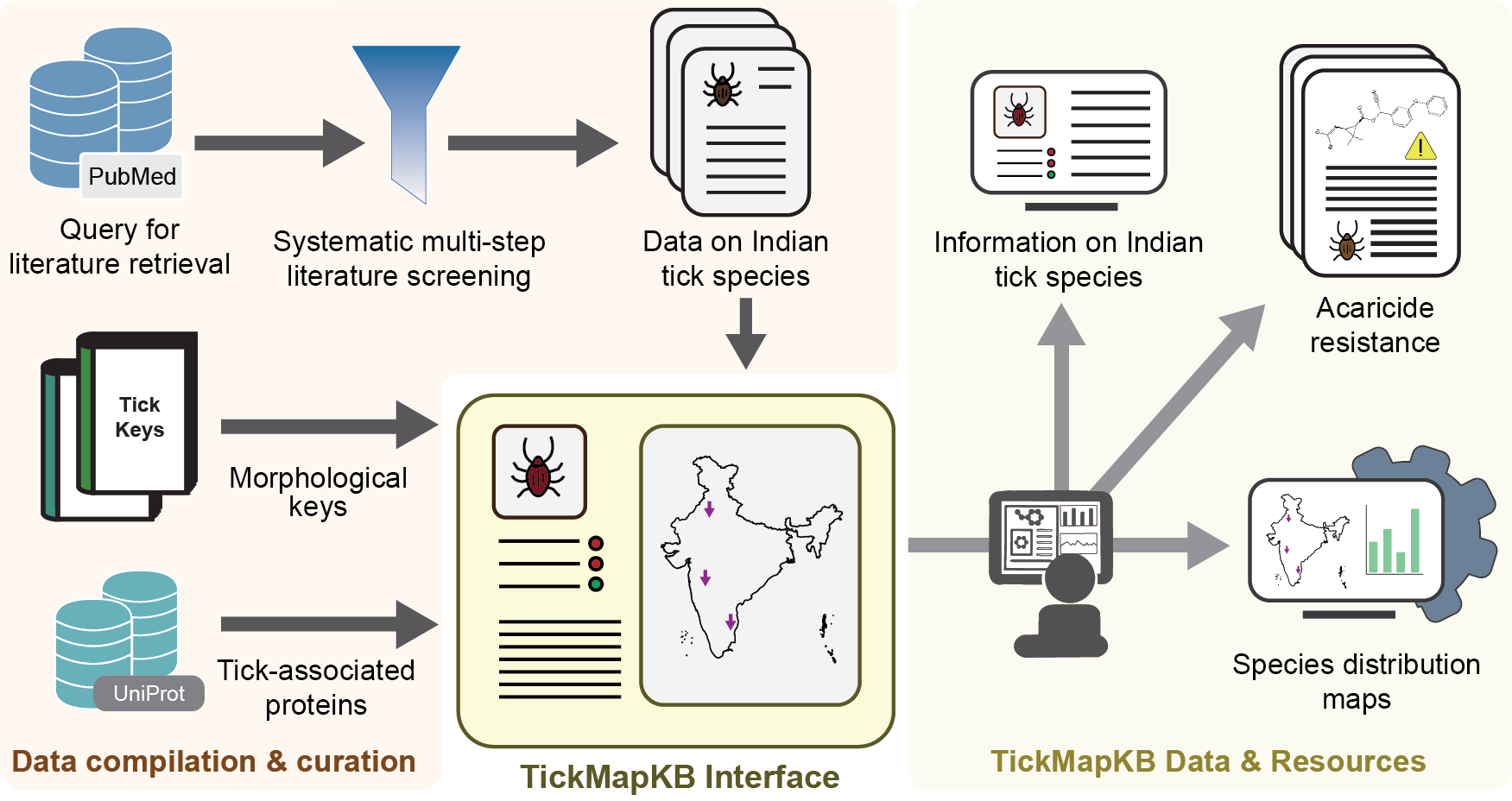
The knowledgebase is organized into three primary modules:
- Species Data: Biological and ecological information on over 70 tick species documented across more than 600 georeferenced locations spanning India, including associated host organisms, sampling methods, over 50 tick-borne diseases with their causative pathogens and clinical symptoms, and morphological identification keys.
- Protein Data: Proteome-level annotations for tick species with documented genomic data, sourced from UniProt. Includes subcellular localization, Gene Ontology (GO) terms for biological process and molecular function, keyword classifications, and links to protein structures in the Protein Data Bank (PDB).
- Chemicals: Acaricide resistance profiles across geographic locations for commonly used compounds.
- Species Distribution Maps: Species-level spatial distribution maps to support surveillance planning and disease risk assessment across India.
The first version of the database was released in June 2026.
STATISTICS & FEATURES
CITATION
If you use our resource, please cite the following research article:S. R. Madgaonkar, S. Vashishth, E. Ayyanar, S. Srirama, & A. Samal*, TickMapKB: A FAIR knowledgebase of ticks and associated pathogens for India, bioRxiv, 2026.06.22.733803 (2026).
DISCLAIMER
TickMapKB is a database of tick species, their distribution, and associated data, compiled from published literature and publicly available sources. The authors are not liable for any inaccuracies or omissions in this resource. This database is intended to support research on tick ecology and distribution and does not necessarily reflect the views or objectives of the authors’ affiliated institutions or funders.