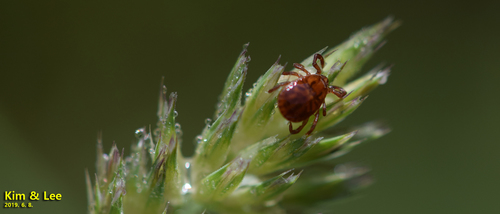
"The scutum is almost as broad as it is long, featuring a rounded outline widest at mid-length, numerous punctations (slightly larger and deeper than the male's), and cervical grooves that are narrow anteriorly but become wide and shallow posteriorly, extending beyond the mid-length
Ventrally, the genital aperture is broadly ""U"" shaped
The capitulum has a basis dorsally twice as broad as long with small, round-tipped cornua (~1/5 the basis length) and large, broadly oval, tilted porose areas
The palpi are short, compact, and sub-conical, while the hypostome (shorter than the palpi and 2.2 times as long as broad) has a 4/4 dental formula with up to 10–11 denticles per file
The legs feature coxal spurs slightly smaller than the male's, particularly on coxa IV."
Sharif, M. “A Revision of the Indian Ixodidae with Special Reference to the Collection in the Indian Museum.” Records of the Zoological Survey of India, September 30, 1928, 217–344. https://doi.org/10.26515/rzsi/v30/i3/1928/162556.
Trapido, H., M. G. R. Varma, P. K. Rajagopalan, K. R. P. Singh, and M. J. Rebello. “A Guide to the Identification of All Stages of the Haemaphysalis Ticks of South India.” Bulletin of Entomological Research 55, no. 2 (1964): 249–70. https://doi.org/10.1017/S0007485300049439.
Geevarghese, G., and A. C. Mishra. “Introduction.” In Haemaphysalis Ticks of India. Elsevier, 2011. https://doi.org/10.1016/B978-0-12-387811-3.00001-2.
Larva
The body measures ~0.85 x 0.60 mm
The scutum (0.33 x 0.38 mm, widest near mid-length) has shallow, concave cervical grooves
The capitulum (slightly broader than long at 0.17 x 0.19 mm) features a basis dorsally ~2.3 times as broad as long with small, round-tipped cornua, palpi with a small posterolateral salience, and a hypostome extending slightly beyond the palpi apex with a 2/2 dental formula of ~7 teeth per file
The legs have a small sub-triangular spur (rounded posteriorly) on coxa I, and small ridge-like spurs on coxae II and III.
Sharif, M. “A Revision of the Indian Ixodidae with Special Reference to the Collection in the Indian Museum.” Records of the Zoological Survey of India, September 30, 1928, 217–344. https://doi.org/10.26515/rzsi/v30/i3/1928/162556.
Trapido, H., M. G. R. Varma, P. K. Rajagopalan, K. R. P. Singh, and M. J. Rebello. “A Guide to the Identification of All Stages of the Haemaphysalis Ticks of South India.” Bulletin of Entomological Research 55, no. 2 (1964): 249–70. https://doi.org/10.1017/S0007485300049439.
Geevarghese, G., and A. C. Mishra. “Introduction.” In Haemaphysalis Ticks of India. Elsevier, 2011. https://doi.org/10.1016/B978-0-12-387811-3.00001-2.
Male
The capitulum is slightly longer than it is broad, featuring a basis dorsally ~1.3 times as broad as long with a few fine punctations and triangular, pointed cornua (~1/3 the basis length)
The palpi are short, compact, and trapezoidal with a small posteroexternal salience, and the hypostome (shorter than the palpi) has a 4/4 dental formula of up to 9–10 denticles per file
The scutum (~1.4 times as long as broad and widest at the spiracular apices) features obsolete cervical grooves, short lateral grooves reaching the mid-length, 11 festoons, and a moderate number of small, shallow, evenly distributed punctations
The legs possess a small, sub-triangular spur with a rounded apex on coxa I
A larger, bluntly pointed triangular spur on coxae II and III (with III being longer and sharper than II)
And an elongate, tapering, narrowly pointed spur on coxa IV that is about half as long as the coxa itself.
Sharif, M. “A Revision of the Indian Ixodidae with Special Reference to the Collection in the Indian Museum.” Records of the Zoological Survey of India, September 30, 1928, 217–344. https://doi.org/10.26515/rzsi/v30/i3/1928/162556.
Trapido, H., M. G. R. Varma, P. K. Rajagopalan, K. R. P. Singh, and M. J. Rebello. “A Guide to the Identification of All Stages of the Haemaphysalis Ticks of South India.” Bulletin of Entomological Research 55, no. 2 (1964): 249–70. https://doi.org/10.1017/S0007485300049439.
Geevarghese, G., and A. C. Mishra. “Introduction.” In Haemaphysalis Ticks of India. Elsevier, 2011. https://doi.org/10.1016/B978-0-12-387811-3.00001-2.
Nymph
The body measures 1.67 x 1.02 mm
The rounded scutum (0.57 x 0.62 mm) features shallow or obsolete cervical grooves and short, shallow marginal grooves that run from the level of the posterior margin of coxa II to the first festoon
The capitulum (0.31 mm, almost as long as broad) has a basis dorsally ~twice as broad as long with triangular cornua (~1/5 the basis length), short trapezoidal palpi with a small posteroexternal salience, and a hypostome (~as long as the palpi) with a 2/2 dental formula of ~7 teeth per file
The legs possess small triangular coxal spurs.
Sharif, M. “A Revision of the Indian Ixodidae with Special Reference to the Collection in the Indian Museum.” Records of the Zoological Survey of India, September 30, 1928, 217–344. https://doi.org/10.26515/rzsi/v30/i3/1928/162556.
Trapido, H., M. G. R. Varma, P. K. Rajagopalan, K. R. P. Singh, and M. J. Rebello. “A Guide to the Identification of All Stages of the Haemaphysalis Ticks of South India.” Bulletin of Entomological Research 55, no. 2 (1964): 249–70. https://doi.org/10.1017/S0007485300049439.
Geevarghese, G., and A. C. Mishra. “Introduction.” In Haemaphysalis Ticks of India. Elsevier, 2011. https://doi.org/10.1016/B978-0-12-387811-3.00001-2.
TickMapKB is a database of tick species, their distribution, and associated data, compiled from published literature and publicly available sources. The authors are not liable for any inaccuracies or omissions in this resource. This database is intended to support research on tick ecology and distribution and does not necessarily reflect the views or objectives of the authors’ affiliated institutions or funders.