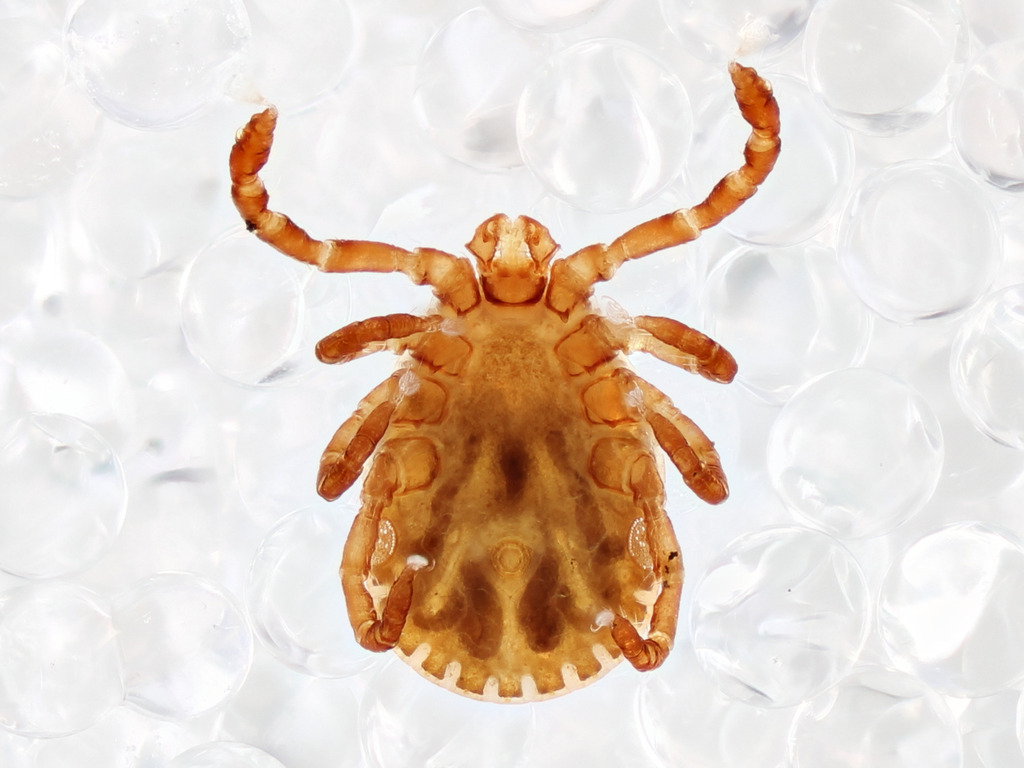
The unengorged body measures ~2.65 mm in length and 1.8 mm in breadth
The scutum (as broad as it is long) has somewhat angular margins, punctations resembling the male's, and narrow converging cervical grooves that continue posteriorly as shallow diverging depressions
Ventrally, the genital operculum is simple and elongate with a truncate posterior margin, and the spiracular plates possess an angularly convex ventral margin with a short, blunt dorsal projection
The capitulum features a basis 2.35 times as broad as long with broadly triangular cornua, oval to subcircular widely spaced porose areas, palpi resembling the male's but with a lanceolate ventral spur on segment 3, and a hypostome with a 5/5 dental formula of 7–9 denticles per file
The legs possess coxal spurs on II–IV that extend well beyond the posterior margin, and a more rounded, shorter ventral spur on trochanter I compared to the male.
Hoogstraal, Harry, Frederick H. S. Roberts, Glen M. Kohls, and Vernon J. Tipton. “Review of Haemaphysalis (Kaiseriana) Longicornis Neumann (Resurrected) of Australia, New Zealand, New Caledonia, Fiji, Japan, Korea, and Northeastern China and USSR, and Its Parthenogenetic and Bisexual Populations (Ixodoidea, Ixodidae).” The Journal of Parasitology 54, no. 6 (1968): 1197–213. https://doi.org/10.2307/3276992.
Larva
The unengorged body measures 0.58 - 0.62 mm in length and 0.47–0.51 mm in breadth
The scutum is ~1.6 times as broad as it is long
The capitulum features a basis 2.6 times as broad as long with cornua reduced to rounded posteroexternal bulges, palpi outlines resembling the nymph's, and a hypostome with a 2/2 dental formula of 5–7 denticles per file
The legs possess a broadly triangular spur on coxa I (slightly shorter than the nymph's) and slightly elevated ridges on coxae II and III.
Hoogstraal, Harry, Frederick H. S. Roberts, Glen M. Kohls, and Vernon J. Tipton. “Review of Haemaphysalis (Kaiseriana) Longicornis Neumann (Resurrected) of Australia, New Zealand, New Caledonia, Fiji, Japan, Korea, and Northeastern China and USSR, and Its Parthenogenetic and Bisexual Populations (Ixodoidea, Ixodidae).” The Journal of Parasitology 54, no. 6 (1968): 1197–213. https://doi.org/10.2307/3276992.
Male
The reddish-yellow body measures approximately 2.51 mm in length and 1.65 mm in breadth
The flat, broadly oval scutum features 11 festoons, narrow lateral grooves enclosing the first festoon, short converging cervical grooves, and numerous, discrete, moderately deep, fairly regularly distributed punctations
Ventrally, the spiracular plates are subquadrate with a blunt, undifferentiated dorsal projection
The capitulum possesses a basis dorsally ~1.66 times as broad as long with pointed triangular cornua, moderately salient palpi (featuring an elevated, sharply pointed dorsal spur and a narrowly pointed ventral spur on segment 3), and a short, stout hypostome with a 5/5 dental formula of 8 - 10 denticles per file
The legs feature an elongate, spinelike, bluntly pointed spur on coxa I, subequal broadly triangular spurs on coxae II and III, a slightly smaller spur on coxa IV, and a sharply pointed dorsal plate on trochanter I.
Hoogstraal, Harry, Frederick H. S. Roberts, Glen M. Kohls, and Vernon J. Tipton. “Review of Haemaphysalis (Kaiseriana) Longicornis Neumann (Resurrected) of Australia, New Zealand, New Caledonia, Fiji, Japan, Korea, and Northeastern China and USSR, and Its Parthenogenetic and Bisexual Populations (Ixodoidea, Ixodidae).” The Journal of Parasitology 54, no. 6 (1968): 1197–213. https://doi.org/10.2307/3276992.
Nymph
The unengorged body measures ~1.76 mm in length and 1.00 mm in breadth
The broadly rounded scutum (1.25 times as broad as long) has narrow, parallel cervical grooves and rare punctations
Ventrally, the spiracular plates are subcircular with a bluntly triangular dorsal extension
The capitulum has a basis ~twice as broad as long with broadly triangular cornua, palpi resembling the female's but lacking a dorsal spur on segment 3, and a hypostome with a 3/3 dental formula of 6 denticles per file
The legs feature coxal spurs identical to the female's, lack ventral trochantal spurs entirely, and possess narrowly elongate tarsi.
Hoogstraal, Harry, Frederick H. S. Roberts, Glen M. Kohls, and Vernon J. Tipton. “Review of Haemaphysalis (Kaiseriana) Longicornis Neumann (Resurrected) of Australia, New Zealand, New Caledonia, Fiji, Japan, Korea, and Northeastern China and USSR, and Its Parthenogenetic and Bisexual Populations (Ixodoidea, Ixodidae).” The Journal of Parasitology 54, no. 6 (1968): 1197–213. https://doi.org/10.2307/3276992.
TickMapKB is a database of tick species, their distribution, and associated data, compiled from published literature and publicly available sources. The authors are not liable for any inaccuracies or omissions in this resource. This database is intended to support research on tick ecology and distribution and does not necessarily reflect the views or objectives of the authors’ affiliated institutions or funders.