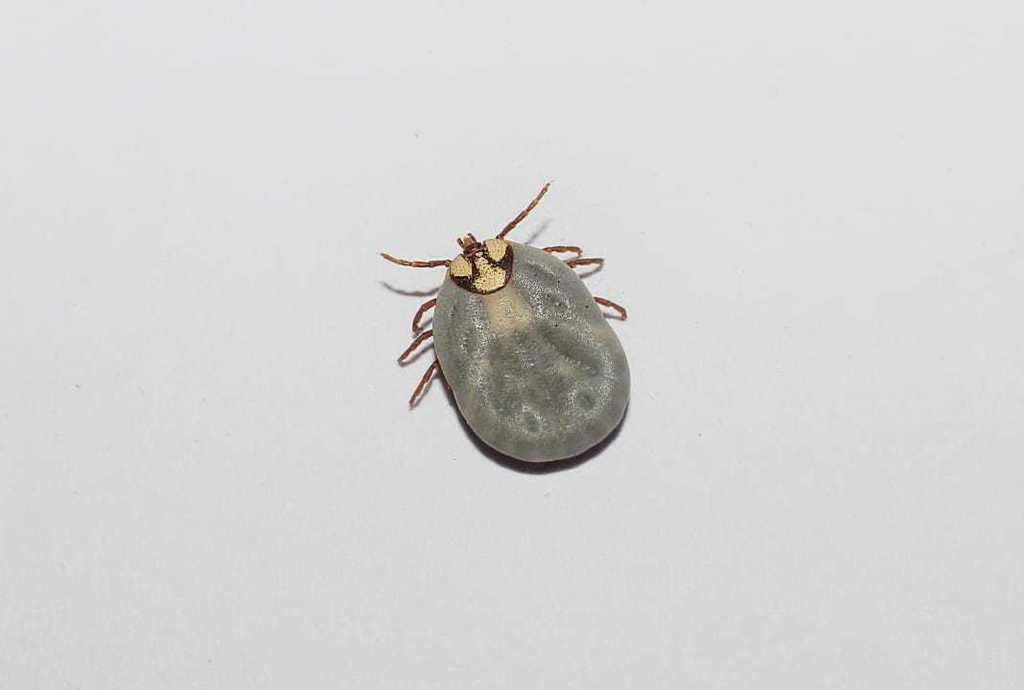
The cordiform scutum is broader than long (1.4 - 1.7 mm by 1.6 - 1.9 mm), widest in the anterior third, and features prominent brown stripes that reduce the metallic green background to three widely separated blotches
It possesses large, unequal punctations, moderately deep emargination, short, deep, externally convex cervical grooves that continue as shallow divergent depressions, and lacks marginal grooves
Ventrally, the sub-triangular spiracle has a thickened antero-dorsal margin and a short, posteriorly pointed macula
The coxal armature matches the male's, though coxa I shows a clearer internal spur, and the legs feature one comparatively small tarsal spur
The 0.83 mm capitulum is stronger and more sub-triangular than the male's, with more convex lateral sides, slightly more prominent cornua, a posteriorly concave dorsal ridge, and a very small, crescent-shaped dorsal process.
Sharif, M. “A Revision of the Indian Ixodidae with Special Reference to the Collection in the Indian Museum.” Records of the Zoological Survey of India, September 30, 1928, 217–344. https://doi.org/10.26515/rzsi/v30/i3/1928/162556.
Male
The body is nearly as broad as or slightly broader than it is long, measuring 1.9–2.4 mm in length and 2 - 2.5 mm in breadth
The scutum features a metallic green background with brown stripes and spots, including a falciform stripe fused with antero-accessory stripes that divide the lateral green blotches, and a narrow postero-median stripe that broadens to fuse with the falciform stripe
It also possesses large, sub-equal punctations, deep, externally convex cervical grooves, deep emargination, and lacks lateral grooves
Ventrally, it has a comma-shaped spiracle with a thickened antero-dorsal margin, an oval anus, and a genital aperture opposite coxa II strengthened by a post-genital chitinous plate
The legs feature very short pads and a short, blunt internal spur on all coxae, with coxa I occasionally having a second obsolete inner spur
The 0.83 mm capitulum has a sub-rectangular base with obsolete cornua, palps four times as long as broad, and a hypostome with 3/3 rows of ~7 strong teeth followed by 4/4 rows of scale-like teeth.
Sharif, M. “A Revision of the Indian Ixodidae with Special Reference to the Collection in the Indian Museum.” Records of the Zoological Survey of India, September 30, 1928, 217–344. https://doi.org/10.26515/rzsi/v30/i3/1928/162556.
Nymph
The inornate, light brown, cordiform scutum measures 0.6 x 0.83 mm and is broadest in the anterior half, featuring a broadly rounded posterior angle and slightly concave or straight postero-lateral sides
It has few, deep, sparsely scattered punctations and narrow, deep cervical grooves that run parallel before diverging and failing to reach the posterior margin
The venter displays a comma-shaped spiracle with an obliquely truncated tail and a very small, sub-circular macula
Legs feature a short, blunt internal spur on coxa I (sometimes paired with an obsolete inner spur), short blunt middle spurs on the other coxae, a humped tarsus IV, and comparatively longer claws than the adults
The 0.33 mm capitulum resembles the female's but has a sub-rectangular base (over three times as broad as long) with poorly developed cornua, and a hypostome armed with 2/2 rows of five strong teeth followed by 3/3 rows of scale-like teeth.
Sharif, M. “A Revision of the Indian Ixodidae with Special Reference to the Collection in the Indian Museum.” Records of the Zoological Survey of India, September 30, 1928, 217–344. https://doi.org/10.26515/rzsi/v30/i3/1928/162556.
TickMapKB is a database of tick species, their distribution, and associated data, compiled from published literature and publicly available sources. The authors are not liable for any inaccuracies or omissions in this resource. This database is intended to support research on tick ecology and distribution and does not necessarily reflect the views or objectives of the authors’ affiliated institutions or funders.