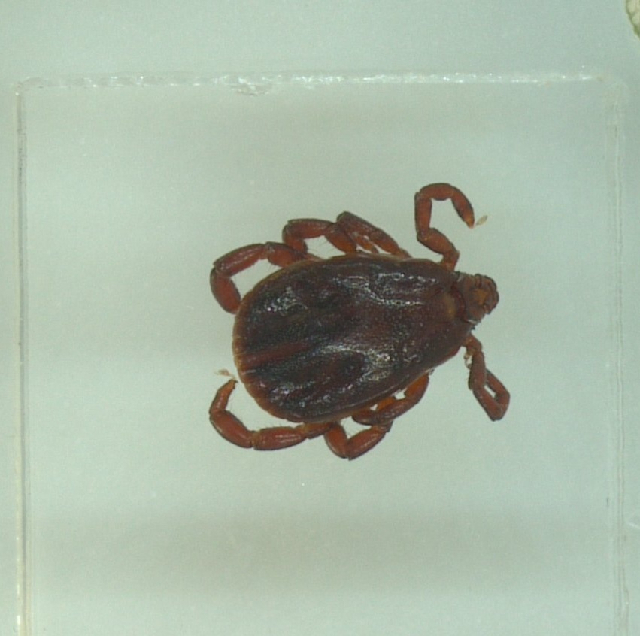
Coxa IV with very short spurs, usually much shorter than the coxa Scutum short oval, or as broad as long
Scutum with large punctations close together
Scutum with regularly distributed punctations
Basis capituli together with palps as broad as long
Posterior border of scutum bending up opposite the lateral grooves.
A. Elango. Hands-on Training Module on Medically Important Hard Ticks (Ixodidae). ICMR-Vector Control Research Centre (VCRC), Puducherry, 2022. https://vcrc.icmr.org.in/images/pdf/Manuals/Hands_on_Training_on_Medically_Important_Hard_Ticks_ICMR-VCRC.pdf.
Male
Adanal plates triangular or sub-triangular (internal borders straight or slightly concave)
Coxa IV with very short spurs, much shorter than the coxa
Marginal grooves long and deep, commencing near the eyes
Scutum with unequal punctations distributed throughout the whole surface mostly fine and non contiguous.
A. Elango. Hands-on Training Module on Medically Important Hard Ticks (Ixodidae). ICMR-Vector Control Research Centre (VCRC), Puducherry, 2022. https://vcrc.icmr.org.in/images/pdf/Manuals/Hands_on_Training_on_Medically_Important_Hard_Ticks_ICMR-VCRC.pdf.
Ventrally coxae l each with a long narrow external spur and a shorter, broader internal spur
Coxae II to IV each with an external spur only.
A. Elango. Hands-on Training Module on Medically Important Hard Ticks (Ixodidae). ICMR-Vector Control Research Centre (VCRC), Puducherry, 2022. https://vcrc.icmr.org.in/images/pdf/Manuals/Hands_on_Training_on_Medically_Important_Hard_Ticks_ICMR-VCRC.pdf.
TickMapKB is a database of tick species, their distribution, and associated data, compiled from published literature and publicly available sources. The authors are not liable for any inaccuracies or omissions in this resource. This database is intended to support research on tick ecology and distribution and does not necessarily reflect the views or objectives of the authors’ affiliated institutions or funders.