Rhipicephalus decoloratus

Unique identifier: 63
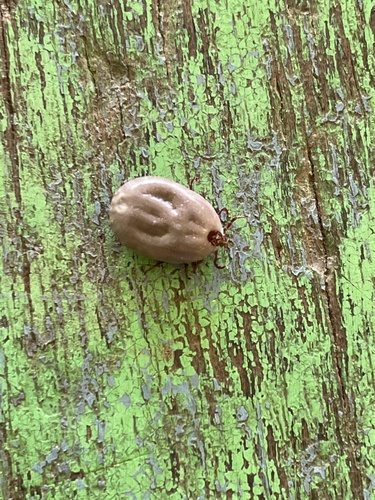
Rhipicephalus decoloratus
© paulinebullock (CC BY-NC)

Morphological Keys

Stage/Sex Morphological Keys
Female
  • The short mouthparts share the hexagonal basis capituli, 3/3 hypostome dentition, and the bristle-bearing protuberance on the first palpal segment seen in the male
  • The scutum lacks festoons, has difficult-to-see eyes, bears numerous fine hairs, and is divided by two distinct grooves into a central yellow area and two reddish-brown lateral areas
  • The engorged female turns blue, frequently displaying a constriction in the middle and a rather soft-looking integument, and possesses pale yellow, slender legs with beady segments.
  • Maxime Madder, Ivan Horak, and Hein Stoltsz. “Ticks Identification.” Ticks, African Veterinary Information Portal (AFRIVIP). Accessed April 6, 2026. https://www.afrivip.org/sites/default/files/Ticks_identification/index.html.
Male
  • The short mouthparts feature a hexagonal basis capituli, a 3/3 hypostome dentition pattern, and a bristle-bearing protuberance on the internal margin of the first palpal segment
  • The yellowish conscutum lacks festoons, bears numerous fine hairs, has difficult-to-see eyes, and is often so poorly sclerotized that the underlying gut outlines are visible
  • A small caudal process is present, and the protruding tips of the adanal and accessory adanal plates can be seen from above, with the adanal plates specifically featuring a long, narrow, posteriorly directed internal spur and a shorter external spur
  • The pale yellow, slender legs have segments with a beady appearance.
  • Maxime Madder, Ivan Horak, and Hein Stoltsz. “Ticks Identification.” Ticks, African Veterinary Information Portal (AFRIVIP). Accessed April 6, 2026. https://www.afrivip.org/sites/default/files/Ticks_identification/index.html.
DISCLAIMER

TickMapKB is a database of tick species, their distribution, and associated data, compiled from published literature and publicly available sources. The authors are not liable for any inaccuracies or omissions in this resource. This database is intended to support research on tick ecology and distribution and does not necessarily reflect the views or objectives of the authors’ affiliated institutions or funders.