Rhipicephalus geigyi

Unique identifier: 64
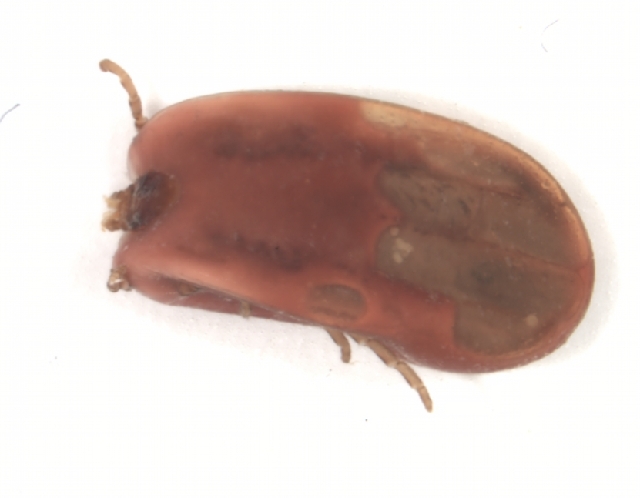
Rhipicephalus geigyi
© Centre for Biodiversity Genomics Photography Group (CC BY)

Morphological Keys

Stage/Sex Morphological Keys
Female
  • The barely engorged body measures 2.5 mm in length and 1.25 mm in width
  • The scutum is slightly longer than it is wide, featuring concave cervical grooves that extend to the lateral margin, and seta-bearing punctations concentrated in the central field and on the scapulae
  • The capitulum has a hexagonal basis (~2.5 times as wide as long) with discrete, rounded cornua, large ellipsoidal porose areas separated by a distance equal to their largest diameter, short palps where segment I features a protuberance with a strong lateral seta, and a hypostome with a 4/4 dental formula
  • The coxal armature is similar to the male's, displaying a divided coxa I with two spines, small external scale-like spines on coxae II and III, and an unarmed coxa IV.
  • Aeschlimann, André, and P. C. Morel. “Boophilus geigyi n.sp. (Acarina Ixodoidea) une nouvelle tique du bétail de l’Ouest Africain.” Acta Tropica, Elsevier, 1965/22/2/162-168, 1965. https://libra.unine.ch/handle/20.500.14713/61246.
Male
  • The body measures 1.9 mm in length and 0.96 mm in width
  • The conscutum (1.51 - 1.89 x 0.86 - 0.99 mm) features a sinuous outline, strong scapulae, short divergent cervical grooves, and regularly distributed seta-bearing punctations
  • Ventrally, it possesses a median caudal appendage, elongated adanal plates ending in two points (with the internal point being stronger and capable of exceeding the posterior body margin), and smaller accessory plates that also bear a well-developed point
  • The capitulum has a hexagonal basis (~2.5 times as wide as long) with very slightly salient, rounded cornua, stocky palps where segment I has a characteristic protuberance bearing a single seta, and a hypostome with a 4/4 dental formula
  • The legs feature a deeply divided coxa I with two strongly chitinized spurs (the internal is wider and rounded
  • The external is thinner and acute), a small external scale-like spine on coxae II and III, and an unarmed coxa IV.
  • Aeschlimann, André, and P. C. Morel. “Boophilus geigyi n.sp. (Acarina Ixodoidea) une nouvelle tique du bétail de l’Ouest Africain.” Acta Tropica, Elsevier, 1965/22/2/162-168, 1965. https://libra.unine.ch/handle/20.500.14713/61246.
DISCLAIMER

TickMapKB is a database of tick species, their distribution, and associated data, compiled from published literature and publicly available sources. The authors are not liable for any inaccuracies or omissions in this resource. This database is intended to support research on tick ecology and distribution and does not necessarily reflect the views or objectives of the authors’ affiliated institutions or funders.