Hyalomma anatolicum

Unique identifier: 42
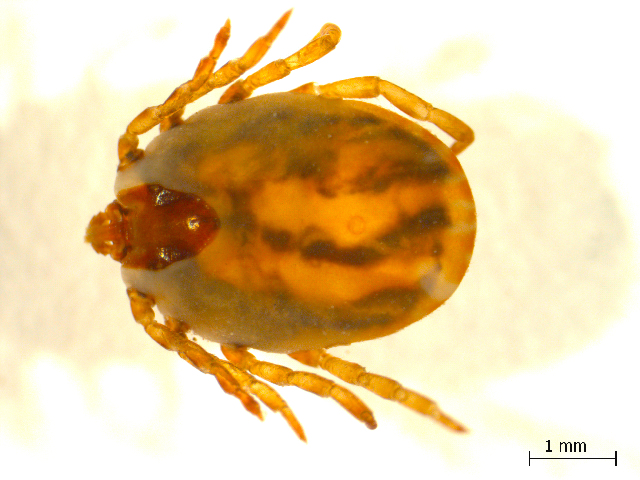
Hyalomma anatolicum
© Centre for Biodiversity Genomics Photography Group (CC BY)

Morphological Keys

Stage/Sex Morphological Keys
Female
  • Bulging, small, knob-like genital operculum which is usually circular in outline
  • Scutum is usually longer than wide with a narrowly rounded posterior margin, with a few large punctuations in the central field and scapular areas, and a variable number of very fine, superficial punctuations over much of the surface.
  • A. Elango. Hands-on Training Module on Medically Important Hard Ticks (Ixodidae). ICMR-Vector Control Research Centre (VCRC), Puducherry, 2022. https://vcrc.icmr.org.in/images/pdf/Manuals/Hands_on_Training_on_Medically_Important_Hard_Ticks_ICMR-VCRC.pdf.
Male
  • Body small, somewhat elongated, yellowish-brown, with a convex, lightly punctuated scutum with short but distinct lateral grooves
  • A pronounced postero-median groove not reaching the parma
  • And small subanal shields directly posterior to the adanal shields.
  • A. Elango. Hands-on Training Module on Medically Important Hard Ticks (Ixodidae). ICMR-Vector Control Research Centre (VCRC), Puducherry, 2022. https://vcrc.icmr.org.in/images/pdf/Manuals/Hands_on_Training_on_Medically_Important_Hard_Ticks_ICMR-VCRC.pdf.
Nymph
  • Body elongated, widest at the level of coxa IV
  • Basis capituli dorsally triangular in outline
  • Posterior margin slightly convex
  • Ventrally posterior margin bow-shaped
  • Coxa I with 2 narrow spurs almost equal in length
  • Coxae II and III each with a small triangular spur
  • Coxa IV with much reduced spur.
  • A. Elango. Hands-on Training Module on Medically Important Hard Ticks (Ixodidae). ICMR-Vector Control Research Centre (VCRC), Puducherry, 2022. https://vcrc.icmr.org.in/images/pdf/Manuals/Hands_on_Training_on_Medically_Important_Hard_Ticks_ICMR-VCRC.pdf.
DISCLAIMER

TickMapKB is a database of tick species, their distribution, and associated data, compiled from published literature and publicly available sources. The authors are not liable for any inaccuracies or omissions in this resource. This database is intended to support research on tick ecology and distribution and does not necessarily reflect the views or objectives of the authors’ affiliated institutions or funders.