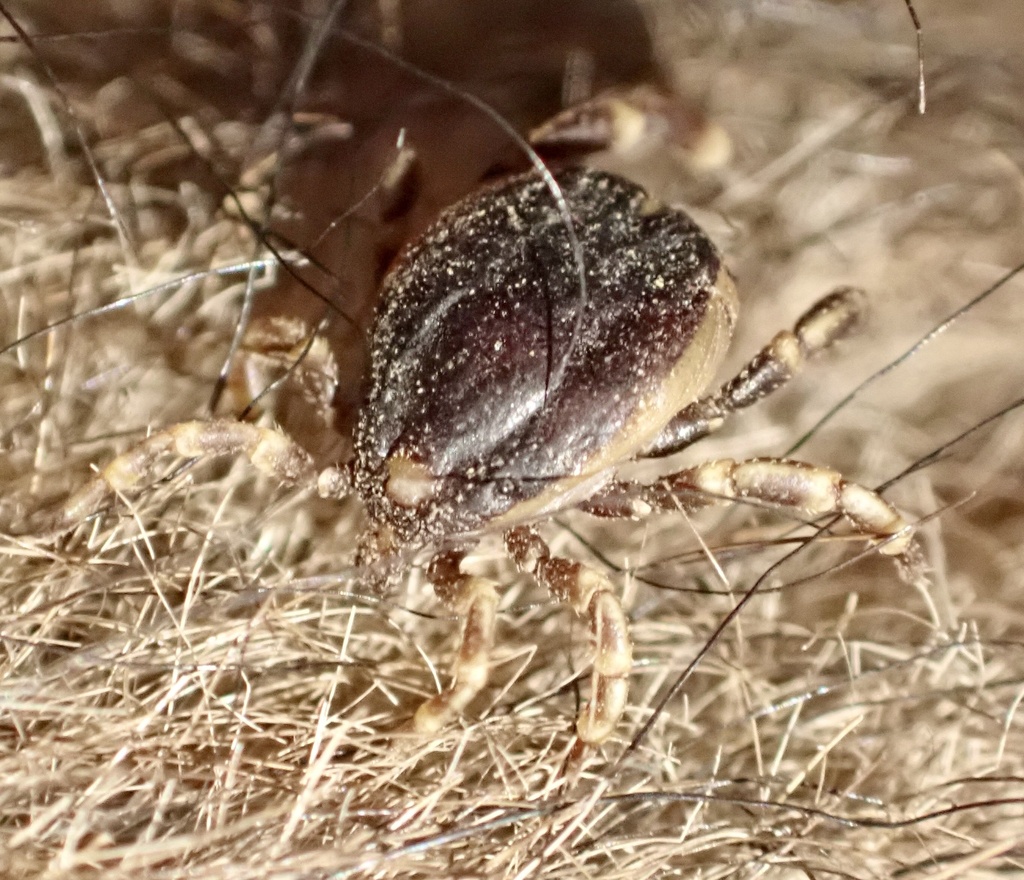
The female features a scutum with an approximately equal length-to-width ratio, an often rugose surface, and few, large punctations
The genital operculum is elongately triangular in outline, gradually depressed in profile, and is surrounded by a narrow, raised integumental fold.
Sharif, M. “A Revision of the Indian Ixodidae with Special Reference to the Collection in the Indian Museum.” Records of the Zoological Survey of India, September 30, 1928, 217–344. https://doi.org/10.26515/rzsi/v30/i3/1928/162556.
Kaiser, M. N., and H. Hoogstraal. “The Hyalomma Ticks (Ixodoidea, Ixodidae) of Pakistan, India and Ceylon, with Keys to Subgenera and Species.” Acarologia 6, no. 2 (1964): 257–86. https://doi.org/.
Male
The male is generally larger than H. anatolicum, featuring a flat body that is as broad as long (measuring between 4.5 x 4.2 mm and 5.7 x 5.7 mm) due to considerable lateral body extensions beyond the less chitinous scutum
The scutum bears a few large, shallow, scattered punctations with others rare or absent, a distinct white median festoon (parma), and 11 total festoons, of which only five have grooves on the scutum
The scutal grooves are generally shallow: cervical grooves are broad, posteriorly divergent, and continuous with postero-lateral grooves
The median groove is narrow and superficial
Lateral grooves are poorly developed, hardly visible anteriorly, and limited to the posterior third
And a deep, narrow posteromedian groove extends from the parma to the scutal midlength, bounded by converging ridges and deep, rugose paramedian grooves
Ventrally, subanal shields are displaced laterally, adanal shields feature a middle inner projection, and six to eight (sometimes poorly developed) scutes are present
The 1.3 mm capitulum features short palps with sub-equal articles II and III that are as broad as they are long
Article II has a blunt dorsal retroverted prominence and a wider proximal portion, while article III has a lateral projection
Lastly, the segments of the last three pairs of legs are significantly stronger than those of the first pair.
Sharif, M. “A Revision of the Indian Ixodidae with Special Reference to the Collection in the Indian Museum.” Records of the Zoological Survey of India, September 30, 1928, 217–344. https://doi.org/10.26515/rzsi/v30/i3/1928/162556.
Kaiser, M. N., and H. Hoogstraal. “The Hyalomma Ticks (Ixodoidea, Ixodidae) of Pakistan, India and Ceylon, with Keys to Subgenera and Species.” Acarologia 6, no. 2 (1964): 257–86. https://doi.org/.
TickMapKB is a database of tick species, their distribution, and associated data, compiled from published literature and publicly available sources. The authors are not liable for any inaccuracies or omissions in this resource. This database is intended to support research on tick ecology and distribution and does not necessarily reflect the views or objectives of the authors’ affiliated institutions or funders.