Ixodes acutitarsus

Unique identifier: 52
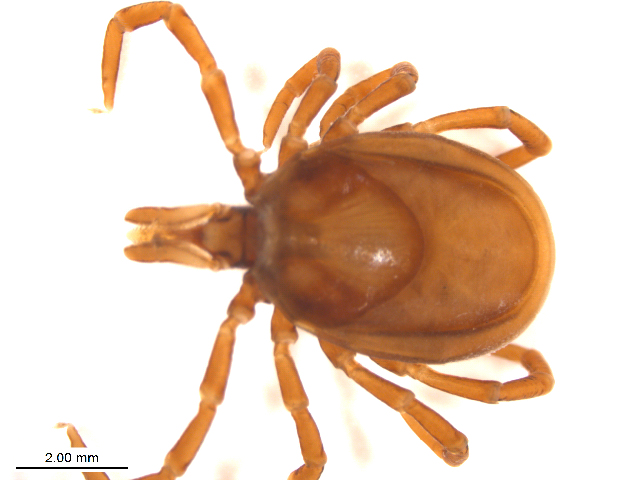
Ixodes acutitarsus
© Centre for Biodiversity Genomics Photography Group (CC BY)

Morphological Keys

Stage/Sex Morphological Keys
Female
  • The body measures 4.5 x 3.5 mm in the smaller examined specimen, featuring a Dresden-brown dorsum with fine, shallow punctations
  • The scutum is broader than long (measuring 2.2 - 2.3 mm long by 2.4 - 2.7 mm broad) and features fine, sparsely scattered punctations that are rare on the median field but abundant on the lateral fields
  • Ventrally, the genital aperture lies opposite the inter-coxal space between coxae III and IV, the anal groove has divergent posterior limbs like the male, and the coxal armature matches the male's
  • The capitulum (1.68 - 1.95 mm long) features a sub-rectangular base with porose areas separated by a distance less than their smallest diameter
  • The palps are four times as long as broad
  • Article I has a slight external salience, while article II is markedly concave externally and bears five short supra-internal hairs
  • The hypostome matches the male's, whereas the external cheliceral article differs by having five cusps and an elongated, curved dorsal process.
  • Sharif, M. “A Revision of the Indian Ixodidae with Special Reference to the Collection in the Indian Museum.” Records of the Zoological Survey of India, September 30, 1928, 217–344. https://doi.org/10.26515/rzsi/v30/i3/1928/162556.
Male
  • The smooth scutum possesses fine, sparsely scattered punctations (most pronounced on the scapulae and between the cervical grooves), continuous, narrow lateral grooves running parallel to the margin, and a broad depression extending from the middle of the cervical groove to the antero-lateral margin
  • Ventrally, it features a slightly hairy surface, a pre-genital plate constricted in its posterior third, a genital aperture with a transverse chitinous plate strengthening its posterior lip, and an anal groove that is rounded in front with slightly divergent posterior limbs
  • The coxal armature resembles Rhipicephalus or Hyalomma: coxa I has two long, sub-equal, pointed spurs overlapping coxa II, and coxae II–IV each have two short spurs (a pointed, narrow external spur and a broad, ridge-like internal spur)
  • The capitulum (1.5 mm long) has a trapezoid base with posteriorly converging lateral sides, palps ~3 times as long as broad (featuring a slightly concave article II with six small supra-internal hairs, and a ventral retroverted spur-like prominence on article III), and a hypostome with a 2/2 dental formula of ~10 teeth per row (external teeth being much larger)
  • The external cheliceral article bears two cusps.
  • Sharif, M. “A Revision of the Indian Ixodidae with Special Reference to the Collection in the Indian Museum.” Records of the Zoological Survey of India, September 30, 1928, 217–344. https://doi.org/10.26515/rzsi/v30/i3/1928/162556.
DISCLAIMER

TickMapKB is a database of tick species, their distribution, and associated data, compiled from published literature and publicly available sources. The authors are not liable for any inaccuracies or omissions in this resource. This database is intended to support research on tick ecology and distribution and does not necessarily reflect the views or objectives of the authors’ affiliated institutions or funders.