Ixodes ovatus

Unique identifier: 54
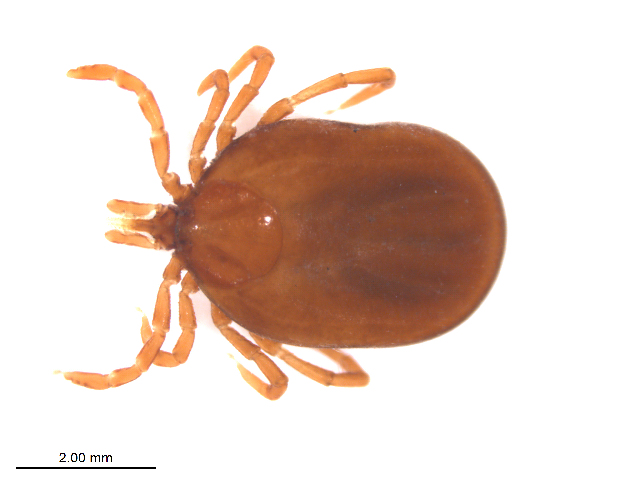
Ixodes ovatus
© Centre for Biodiversity Genomics Photography Group (CC BY)

Morphological Keys

Stage/Sex Morphological Keys
Female
  • The basis capituli is equipped with well-defined cornua and round porous areas
  • Like the male, coxa I features a single short, blunt internal spur
  • Coxa II lacks an external spur and has a convex posterior margin featuring a membranous elevation similar to that of the male.
  • Yamaguti, Noboru, Vernon Tipton, Hugh Keegan, and Seiichi Toshioka. “Ticks of Japan, Korea, and the Ryukyu Islands.” Brigham Young University Science Bulletin, Biological Series 15, no. 1 (1971). https://scholarsarchive.byu.edu/byuscib/vol15/iss1/1.
Male
  • The dorsal aspect resembles I. nipponensis and I. persulcatus
  • Ventrally, it is distinguished by coxae II and III lacking spurs
  • Instead, their posterior halves are covered with milky white, membranous, eavelike elevations, resulting in smoothly convex posterior margins
  • Coxa I possesses a single short, blunt internal spur
  • The spiracular plate is elongate, with a length-to-width ratio greater than 2.0 (approximately 2.3)
  • The hypostome dentition is restricted to the apical half, terminating posteriorly at the same level as the suture between palpal articles II and III.
  • Yamaguti, Noboru, Vernon Tipton, Hugh Keegan, and Seiichi Toshioka. “Ticks of Japan, Korea, and the Ryukyu Islands.” Brigham Young University Science Bulletin, Biological Series 15, no. 1 (1971). https://scholarsarchive.byu.edu/byuscib/vol15/iss1/1.
DISCLAIMER

TickMapKB is a database of tick species, their distribution, and associated data, compiled from published literature and publicly available sources. The authors are not liable for any inaccuracies or omissions in this resource. This database is intended to support research on tick ecology and distribution and does not necessarily reflect the views or objectives of the authors’ affiliated institutions or funders.