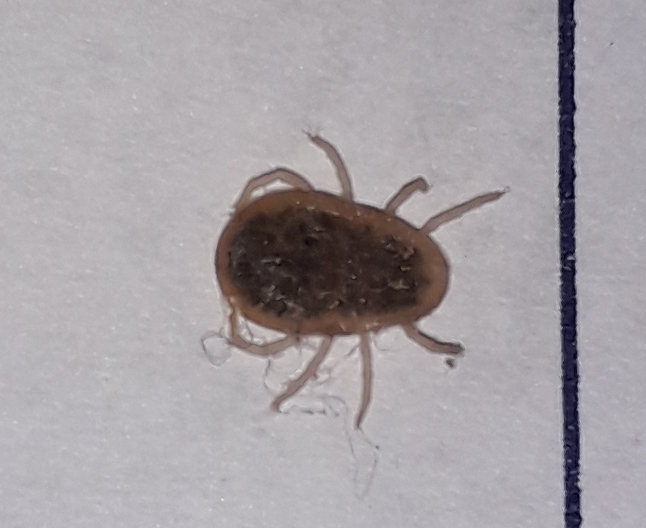
The female shares the same dorsoventrally flattened, ovoid body shape as the male but grows larger, reaching up to 1.2 cm in length
When looking at the ventral side, it also features eight legs, mouthparts, cheliceres, a hypostome, pedipalps, a centrally situated genital opening, and an anus.
Mehlhorn, Heinz. “Argas Species, Leather or Soft Ticks.” In Encyclopedia of Parasitology, edited by Heinz Mehlhorn. Springer Berlin Heidelberg, 2015. https://doi.org/10.1007/978-3-642-27769-6_260-2.
Male
The male pigeon tick has a dorsoventrally flattened body that appears ovoid when viewed from the dorsal side
It looks very similar to the female but is somewhat shorter, reaching up to 7.5 mm in length
Ventrally, it possesses eight legs, mouthparts, cheliceres, a hypostome, pedipalps, a centrally situated genital opening, and an anus.
Mehlhorn, Heinz. “Argas Species, Leather or Soft Ticks.” In Encyclopedia of Parasitology, edited by Heinz Mehlhorn. Springer Berlin Heidelberg, 2015. https://doi.org/10.1007/978-3-642-27769-6_260-2.
Nymph
The nymph also exhibits a dorsoventrally flattened, ovoid body, but it is smaller than the adults, measuring between 3.5 and 6.5 mm in length
Just like the adult stages, its ventral side is characterized by the presence of eight legs, mouthparts, cheliceres, a hypostome, pedipalps, a centrally situated genital opening, and an anus.
Mehlhorn, Heinz. “Argas Species, Leather or Soft Ticks.” In Encyclopedia of Parasitology, edited by Heinz Mehlhorn. Springer Berlin Heidelberg, 2015. https://doi.org/10.1007/978-3-642-27769-6_260-2.
TickMapKB is a database of tick species, their distribution, and associated data, compiled from published literature and publicly available sources. The authors are not liable for any inaccuracies or omissions in this resource. This database is intended to support research on tick ecology and distribution and does not necessarily reflect the views or objectives of the authors’ affiliated institutions or funders.