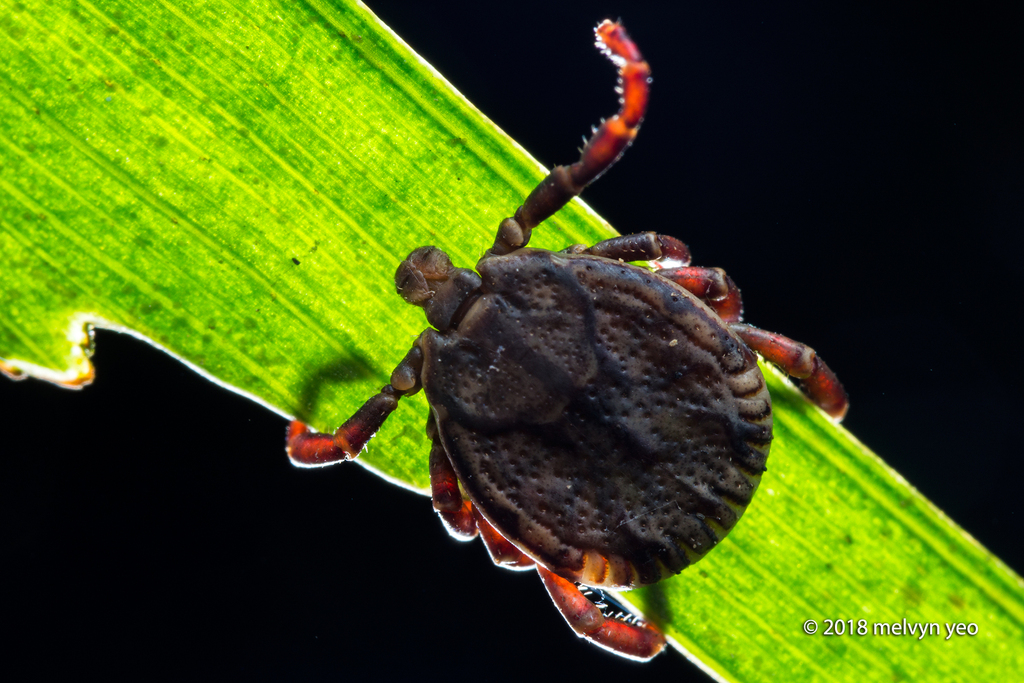
The oval, slightly anteriorly narrowed body features a hairy and wrinkled general dorsal surface and is broadest in front of the spiracle
The broad, sub-hexagonal, ornate scutum is broadest in its anterior third (measuring 1.7 - 2.5 mm long by 2 - 3 mm broad) and features flat yellow eyes, large circular punctations interspersed with fine ones, and a narrow limiting stripe running behind the eyes to meet at the posterior end
Cervical grooves are initially deep and convergent before becoming shallow and divergent, forming a superficially depressed oval cervical field alongside ill-defined lateral grooves
Ventrally, the genital aperture is opposite coxa II, and the sub-triangular spiracle has a strongly truncated dorsal angle and a pointed macula
The leg segments are longer than the male's, with sub-equal, comparatively longer coxae
Coxa I has two spurs, coxae II–IV each have two sub-equal spurs, and tarsus IV features comparatively stronger spurs than the male
The capitulum is comparatively longer (1.5 mm) with stronger cornua and broader-than-long oval porose areas separated by their shortest diameter
The palps are longer than the male's (article II is much longer than III), the hypostome teeth are stronger and more numerous, and the external cheliceral article bears three cusps.
Sharif, M. “A Revision of the Indian Ixodidae with Special Reference to the Collection in the Indian Museum.” Records of the Zoological Survey of India, September 30, 1928, 217–344. https://doi.org/10.26515/rzsi/v30/i3/1928/162556.
Male
The body is oval, narrowing anteriorly, and is broadest in front of the spiracle, with length ranging from 4.2 to 6.5 mm and breadth from 3.25 to 5.2 mm
The scutum features slightly raised brown stripes on a whitish background, including a falciform stripe whose sigmoid horns boundary the pseudo-scutum and fuse with the small ocular spots, as well as an irregular median longitudinal stripe and inward-bending postero-accessory stripes
All festoons are longer than broad with broad brown separating grooves, and except for the typically brown third festoon, they are marked with brown-margined white spots and strengthened by postero-ventral brown scutes
The scutum's punctations are numerous and markedly unequal, featuring large, deep, round pits interspersed with fine ones (large punctations are absent on the stripes), while the cervical grooves are deep and convergent anteriorly but shallow and divergent posteriorly
Ventrally, the genital aperture lies opposite coxa II with a transverse chitinous plate on its lower margin, the anus is broader than long, and the short, comma-shaped spiracle features a blunt macula
The strong, massive, punctate legs are ornate with whitish specks, featuring blunt ventral spine-like processes, a massively enlarged coxa IV (twice the size of others) with multiple short spurs, and two short, progressively decreasing spurs on coxae I, II, and III
The capitulum (1.2 mm long) is ornate and punctate dorsally, with a rectangular base, broad short cornua, and palps twice as long as broad where article II is the largest
The hypostome has 3/3 rows of ~10 equal teeth followed by scale-like teeth, and the external cheliceral article bears two cusps.
Sharif, M. “A Revision of the Indian Ixodidae with Special Reference to the Collection in the Indian Museum.” Records of the Zoological Survey of India, September 30, 1928, 217–344. https://doi.org/10.26515/rzsi/v30/i3/1928/162556.
Nymph
The nymph's brown, sub-hexagonal scutum (0.5 x 0.54 mm) is broadest in the middle, turning reddish-brown near the eyes, and features deep anteriorly convergent cervical grooves that disappear in the posterior third
Punctations are few and superficial, restricted to the posterior portion of the median field, and shallow lateral grooves enclose superficial cervical fields
Ventrally, the spiracle is pear-shaped
The legs feature two fairly strong, equal, well-separated spurs on coxa I, a pointed triangular spur near the external angle of coxae II–IV, and a gradually tapering tarsus IV lacking a ventral spur
The capitulum (0.38 mm long) differs considerably from the adult: the hexagonal base lacks cornua and has strongly pointed lateral angles, while the long distinct palps feature an article II lacking ridges but bearing long hairs
The strongly spatulate hypostome has 3/3 rows of six strong teeth in the anterior half, followed by 2/2 rows of seven scale-like teeth.
Sharif, M. “A Revision of the Indian Ixodidae with Special Reference to the Collection in the Indian Museum.” Records of the Zoological Survey of India, September 30, 1928, 217–344. https://doi.org/10.26515/rzsi/v30/i3/1928/162556.
TickMapKB is a database of tick species, their distribution, and associated data, compiled from published literature and publicly available sources. The authors are not liable for any inaccuracies or omissions in this resource. This database is intended to support research on tick ecology and distribution and does not necessarily reflect the views or objectives of the authors’ affiliated institutions or funders.