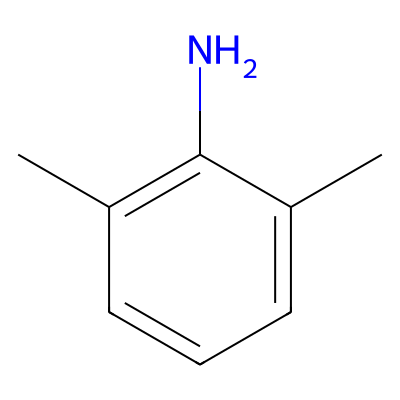
2,6-Dimethylaniline
| Associated curated AOPs from AOP-Wiki |
|---|
Associated AOPs with Level of Relevance 1
AOPs with at least 1 KE associated with chemical, where the KE(s) are neither MIE nor AO
| AOP Identifier | AOP Title | AO Classification | OECD Status | Coverage Score | KE Identifier | KE Name |
|---|---|---|---|---|---|---|
| AOP:19 | Androgen receptor antagonism leading to adverse effects in the male foetus (mammals) | Reproductive System Disease | - | 0.2 | KE:286 | Altered, Transcription of genes by the androgen receptor |
| AOP:272 | Deposition of energy leading to lung cancer | Cancer | WPHA/WNT Endorsed | 0.14 | KE:1636 | Increase, Chromosomal aberrations |
| AOP:305 | 5α-reductase inhibition leading to short anogenital distance (AGD) in male (mammalian) offspring | Unclassified | Under Development | 0.2 | KE:286 | Altered, Transcription of genes by the androgen receptor |
| AOP:306 | Androgen receptor (AR) antagonism leading to short anogenital distance (AGD) in male (mammalian) offspring | Unclassified | Under Development | 0.25 | KE:286 | Altered, Transcription of genes by the androgen receptor |
| AOP:344 | Androgen receptor (AR) antagonism leading to nipple retention (NR) in male (mammalian) offspring | Unclassified | Under Development | 0.25 | KE:286 | Altered, Transcription of genes by the androgen receptor |
| AOP:345 | Androgen receptor (AR) antagonism leading to decreased fertility in females | Endocrine System Disease; Reproductive System Disease; Reproductive System Disease | Under Development | 0.17 | KE:286 | Altered, Transcription of genes by the androgen receptor |
| AOP:372 | Androgen receptor antagonism leading to testicular cancer | Endocrine System Disease; Reproductive System Disease; Cancer | - | 0.2 | KE:286 | Altered, Transcription of genes by the androgen receptor |
| AOP:443 | DNA damage and mutations leading to Metastatic Breast Cancer | Thoracic Disease; Cancer | Under Development | 0.1 | KE:1554 | Increase Chromosomal Aberrations |
| AOP:478 | Deposition of energy leading to occurrence of cataracts | Nervous System Disease; Monogenic Disease | Under Review | 0.1 | KE:1636 | Increase, Chromosomal aberrations |
| AOP:495 | Androgen receptor activation leading to prostate cancer | Reproductive System Disease; Cancer | - | 0.11 | KE:286 | Altered, Transcription of genes by the androgen receptor |
| AOP:496 | Androgen receptor agonism leading to reproduction dysfunction (in zebrafish) | Unclassified | - | 0.1 | KE:286 | Altered, Transcription of genes by the androgen receptor |
| AOP:513 | Reactive Oxygen (ROS) formation leads to cancer via Peroxisome proliferation-activated receptor (PPAR) pathway | Cancer | - | 0.2 | KE:233 | Decreased, PPAR-gamma activation |
Associated AOPs with Level of Relevance 2
AOPs with at least 1 AO associated with chemical, and no associated MIE
| AOP Identifier | AOP Title | AO Classification | OECD Status | Coverage Score | KE Identifier | KE Name |
|---|---|---|---|---|---|---|
| AOP:136 | Intracellular Acidification Induced Olfactory Epithelial Injury Leading to Site of Contact Nasal Tumors | Benign Neoplasm; Respiratory System Disease | Under Review | 0.14 | KE:872 | Increase, Site of Contact Nasal Tumors |
| AOP:296 | Oxidative DNA damage leading to chromosomal aberrations and mutations | Genetic Disease; Chromosomal Disease | WPHA/WNT Endorsed | 0.2 | KE:1636 | Increase, Chromosomal aberrations |
Associated AOPs with Level of Relevance 3
AOPs with at least 1 MIE associated with chemical, and no associated AO
| AOP Identifier | AOP Title | AO Classification | OECD Status | Coverage Score | KE Identifier | KE Name |
|---|---|---|---|---|---|---|
| AOP:36 | Peroxisomal Fatty Acid Beta-Oxidation Inhibition Leading to Steatosis | Gastrointestinal System Disease; Inherited Metabolic Disorder | - | 0.12 | KE:233 | Decreased, PPAR-gamma activation |
DISCLAIMER
TICToK is a knowledgebase of chemicals found in tattoo inks, compiled from publicly available regulatory and scientific resources. The chemical classifications presented in this knowledgebase are derived from multiple publicly available resources and are provided solely for informational purposes, and they are neither authoritative nor binding. The chemical-AOP mappings compiled in this knowledgebase serve as plausible hypotheses for research, and further experimental validation is required to definitively establish these potential toxicity mechanisms. The authors bear no responsibility for any errors, omissions, or inconsistencies originating from these external sources. Users are advised to exercise independent judgment when interpreting chemical classifications and any other data provided in this resource. Importantly, our sole goal to build this resource on tattoo ink chemicals is to enable future basic research on this topic, and it does not necessarily reflect the views or objectives of our employers or funders.