Rhipicephalus annulatus

Unique identifier: 61
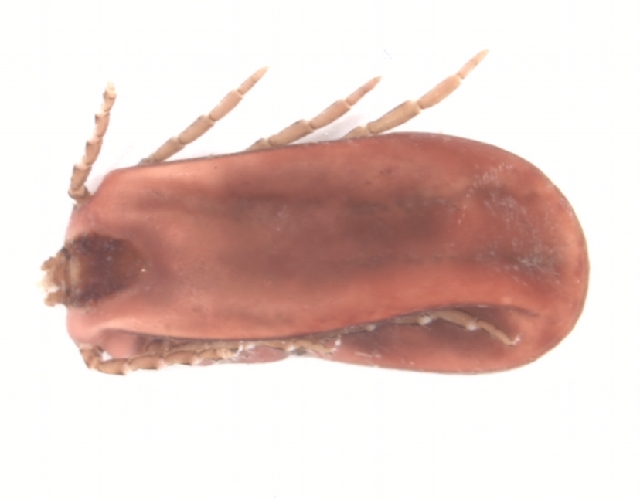
Rhipicephalus annulatus
© Centre for Biodiversity Genomics Photography Group (CC BY)

Morphological Keys

Stage/Sex Morphological Keys
Female
  • Coxa I with very short outer and inner spines, scales wide, not separated by a narrow notch
  • Coxae II-III without an external spur, the postero-external angle marked at most by a bordering ridge
  • 4/4 dentition hypostoma.
  • A. Elango. Hands-on Training Module on Medically Important Hard Ticks (Ixodidae). ICMR-Vector Control Research Centre (VCRC), Puducherry, 2022. https://vcrc.icmr.org.in/images/pdf/Manuals/Hands_on_Training_on_Medically_Important_Hard_Ticks_ICMR-VCRC.pdf.
Male
  • Caudal appendix absent
  • Coxae II-III without external spine
  • Scaly (at the most one postero-external ridge)
  • Coxa I with short external and internal spines
  • Adanal plate to more or less acute postero-internal
  • 4/4 dentition in hypostome.
  • A. Elango. Hands-on Training Module on Medically Important Hard Ticks (Ixodidae). ICMR-Vector Control Research Centre (VCRC), Puducherry, 2022. https://vcrc.icmr.org.in/images/pdf/Manuals/Hands_on_Training_on_Medically_Important_Hard_Ticks_ICMR-VCRC.pdf.
DISCLAIMER

TickMapKB is a database of tick species, their distribution, and associated data, compiled from published literature and publicly available sources. The authors are not liable for any inaccuracies or omissions in this resource. This database is intended to support research on tick ecology and distribution and does not necessarily reflect the views or objectives of the authors’ affiliated institutions or funders.